
Barcelona launches “Barcelona at 50°C”, a project to prepare the city for episodes of extreme heat
Today saw the launch of the project "Barcelona at 50ºC: preparing today to respond better tomorrow", in a ceremony in the Saló de Cent, chaired by the Mayor of Barcelona, Jaume Collboni. This pioneering exercise will test how Barcelona should respond to an episode of extreme heat that simultaneously affects people’s health, the delivery of essential services and coordination between the various stakeholders involved.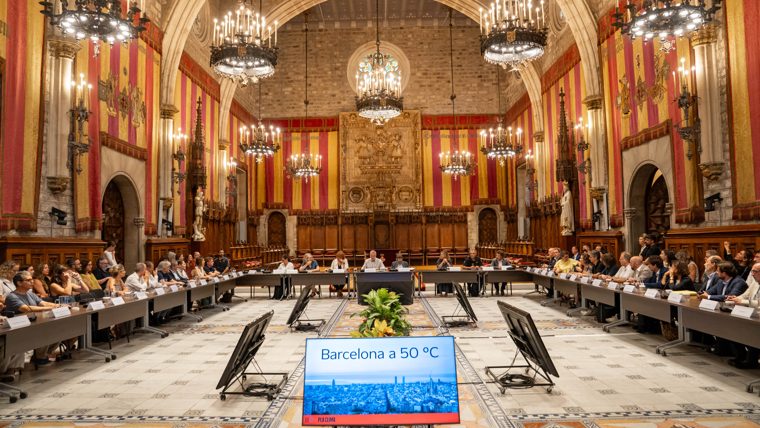 Sessió d'inici del projecte "Barcelona a 50 ºC" al Saló de Cent el 15 de juliol de 2026
Also participating in the session were representatives from the city’s main operational stakeholders, services and urban infrastructures, health, mobility, energy, water, telecommunications, economic activity, labour conditions, public spaces, facilities, communication and support for members of the public.
A strategic initiative forming part of the Heat Plan 2025-2035, the project aims to anticipate weak points, rehearse responses, identify possible knock-on effects for urban services, test existing protocols, strengthen the coordination mechanisms needed in complex situations and adapt the city to climate scenarios that may occur in the coming decades. This way, while the city handles its current adaptation needs, preparations can start being made for more demanding scenarios.
The aim is to determine whether the city’s systems as a whole are capable of delivering the institutional, operational and community response such a situation would require. The findings from the project will be used to update protocols, strengthen institutional coordination and improve Barcelona’s capacity to respond to future episodes of extreme heat.
Workshops and institutional and operational drills
The project will involve a deliberative process and a series of workshops, along with a tabletop exercise and a field-based operational drill recreating the effects of an extreme heat event, enabling the city to observe and assess how the services involved respond in practice.
The workshops begin in October and must serve to share knowledge, identify risks and interdependence, better understand the needs of different sectors and collectives and build a shared perspective on how to strengthen Barcelona’s preparations for extreme heat in the coming decades.
Once the workshops have concluded, a tabletop exercise will be held in February 2027, focusing on decision-making and coordination between municipal services and the city’s stakeholders. This will be followed by a field-based operational simulation, scheduled for September 2027, recreating the effects of an extreme heat event to observe and assess how the services involved respond in practice and to test all relevant protocols.
A multidisciplinary approach involving all relevant stakeholders
An episode of extreme heat may affect various essential services simultaneously. There may also be a knock-on effect meaning that the breakdown or tension of one service may compromise the response capacity of others. To support this analysis, the project will also draw on advanced digital simulation tools.
The response to a climate emergency of this type does not only depend on one service or one administration but requires an understanding of the interdependency of services and other stakeholders, demanding effective communication between the different municipal areas, operators and essential services, other administrations, social organisations, facilities, community networks and the general public. In this respect, Barcelona’s resilience depends on its ability to coordinate all of these stakeholders simultaneously.
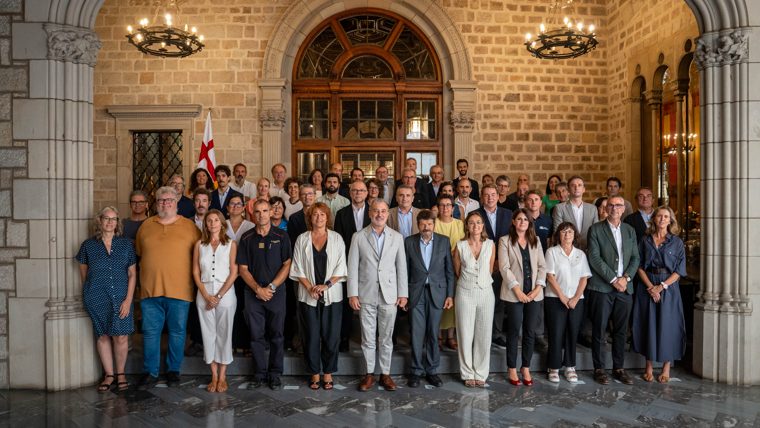
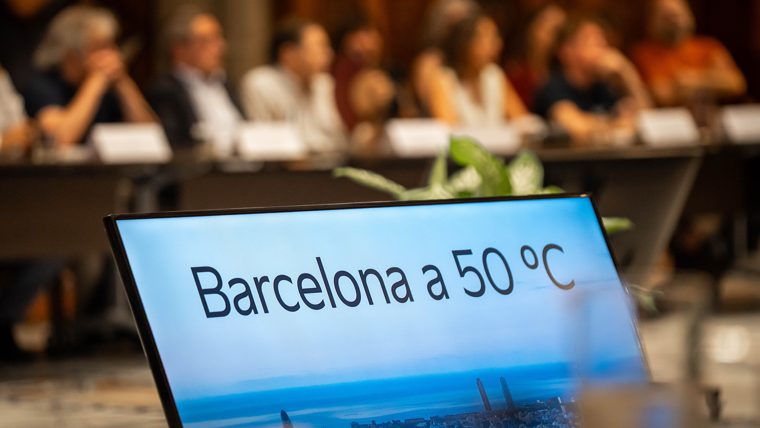
 Foto de família de la jornada d'inici del projecte "Barcelona a 50 ºC" al Saló de Cent el 15 de juliol de 2026
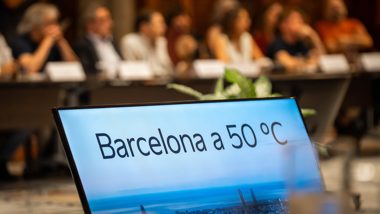 Jornada d'inici del projecte "Barcelona a 50 ºC" al Saló de Cent
