Philippe Aghion receives the 6th Hypatia Prize for his contribution in the realm of the economy
Barcelona City Council, with the collaboration of the Academia Europaea Barcelona Knowledge Hub, awarded Aghion the prize for his pioneering theoretical knowledge and his influence in the sphere of public policies.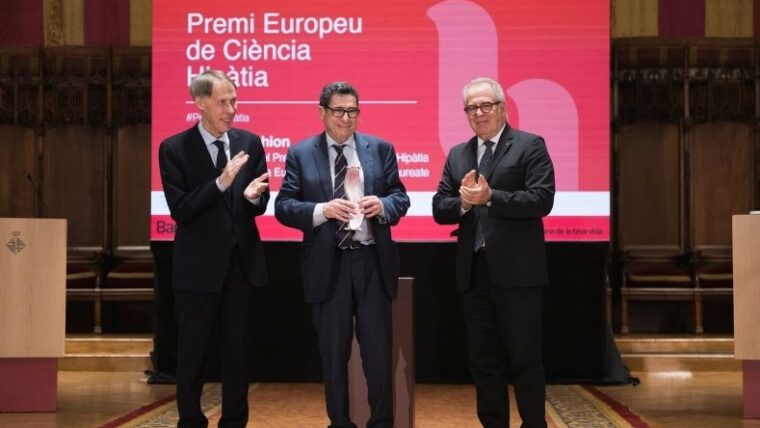
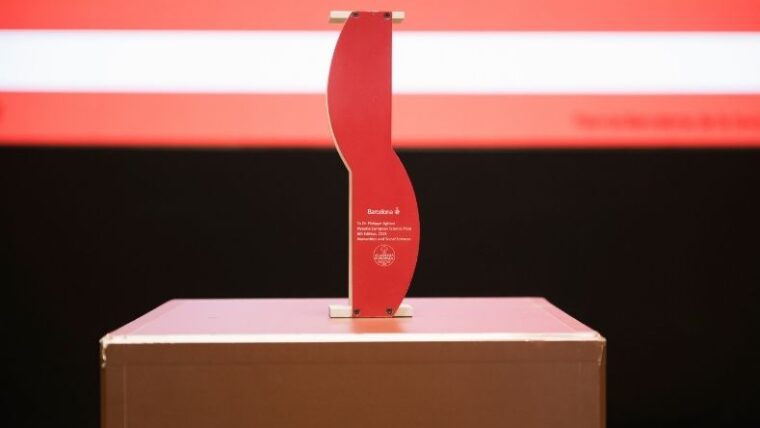
The economist, university professor and winner of the Nobel Prize in economics 2025, Philippe Aghion, received the 6th Hypatia Prize for his distinguished theoretical contributions and influence in the sphere of public policies around the world. This award, which carries a monetary prize of 30,000 euros, is an initiative by Barcelona City Council, developed in collaboration with the Academia Europaea Barcelona Knowledge Hub. Its purpose is to give visibility to research excellence with an international scope and consolidate Barcelona as a European leader in the sphere of science.
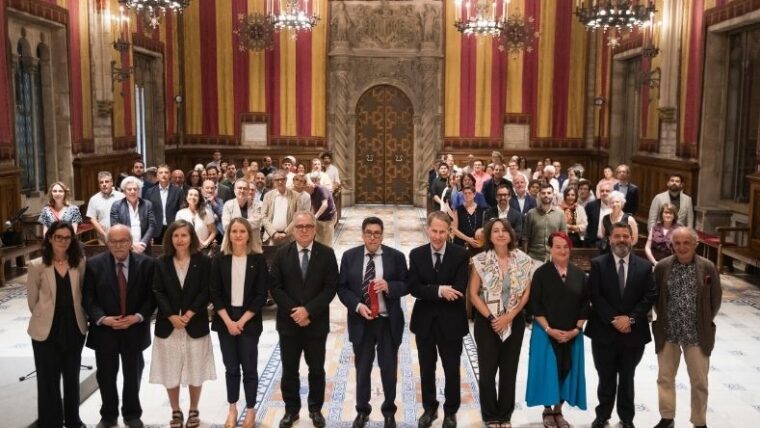
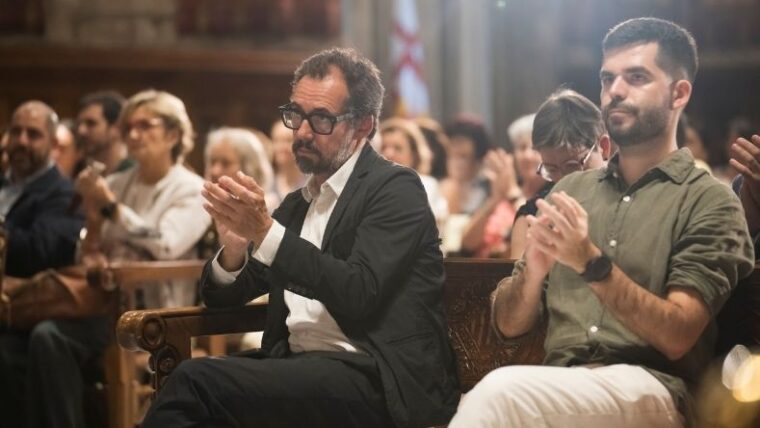
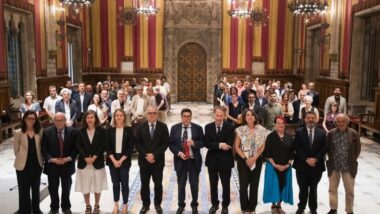
Prize-giving ceremony in the Saló de Cent at Barcelona City Hall
The award ceremony was held this afternoon in the Saló de Cent at Barcelona City Hall. The Deputy Mayor for Economy, Housing, Tax and Tourism, Jordi Valls, gave the Hypatia European Science Prize to Philippe Aghion. This recognition highlights Aghion’s pioneering contributions to the economy of innovation, economic growth and the concept of creative destruction. His theoretical input has had a deep impact in academic research and the design of public policies around the world and has helped towards a better understanding of the factors that drive prosperity and economic development.
The Deputy Mayor emphasised that Aghion’s work helps us to understand that innovation “is not neutral and requires rules and public direction so as not to erode social cohesion”. Similarly, he affirmed that Barcelona “believes that the eruption of artificial intelligence obliges us to act with a European and global vision, but also with solid principles centring on human dignity”.
“Barcelona values ecological humanism as the driving principal for tackling the challenges of artificial intelligence and innovation”, which is why Valls sustained that technology “cannot just be an expression of the interests of those who fund it or sponsor it, but a tool at the service if humanity that moves forward and leaves nobody behind”.
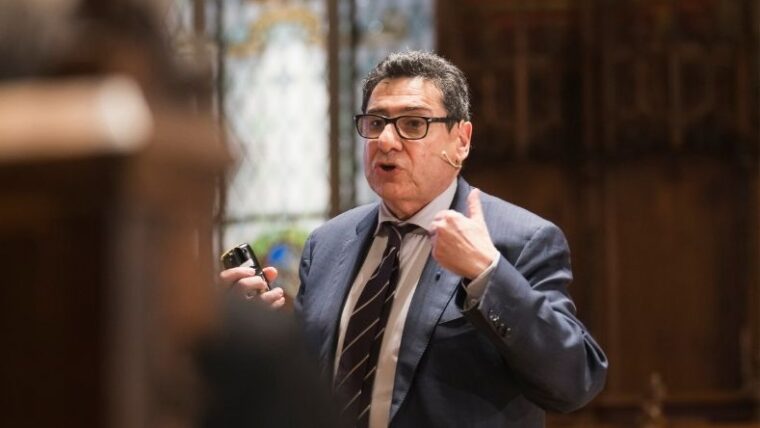
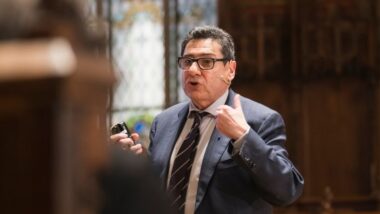
Philippe Aghion started his speech by noting “I am grateful to the city of Barcelona, to Academia Europaea and the jury. I have no words to express how this moves me. It is an honour”. During the ceremony, he offered a presentation entitled “The power of creative destruction and the IA revolution”, where he contextualised the context of the current economic moment, the appearance of AI and the solution that “destructive creation” could bring if we back social and educational policies and support for innovation.
An academic career that has transformed the study of innovation and economic growth
Philippe Aghion is one of the most influential figures in contemporary economics. He earned his PhD in Economics from Harvard University in 1987 and is currently a professor at the Collège de France, INSEAD, and the London School of Economics. Throughout his career, he has made fundamental contributions to the fields of innovation, economic growth, and creative destruction, a concept that explains how new technologies, ideas, and production models drive economic progress while replacing obsolete activities and sectors. Together with Peter Howitt, he co-developed the Schumpeterian growth paradigm, one of the main theoretical frameworks for understanding the dynamics of modern economies and the role of innovation in generating prosperity.
His contributions have had a profound influence on both academic research and the design of public policies at an international level. Author of reference works such as Endogenous Growth Theory (1998), Competition and Growth (2006), and The Power of Creative Destruction (2021), Aghion has accumulated more than 136,000 scientific citations, a testament to the global impact of his work.
The Hypatia Prize: Barcelona as a platform for European research
The Hypatia European Science Prize, created in 2018 within the framework of the first Barcelona Science Plan and awarded annually, is part of the knowledge and innovation promotion strategy driven by the Barcelona City Council and the Academia Europaea. It is also one of the key components of axis 2 of the Strategic Plan for Science and Innovation 2024–2027, focused on international promotion. The prize follows a three-year cycle, alternating each year among the three major fields of knowledge: science and technology; life and health sciences; and humanities and social sciences.
This award recognizes researchers who have excelled in their scientific discipline at an international level and whose work has had a significant impact on society. The prize aims not only to highlight excellent research and its social benefits in Europe, but also to consolidate Barcelona as a scientific reference point at the European level.
With this initiative, the Barcelona City Council seeks to promote excellence in research, increase the public visibility of science, and recognize careers that have significantly advanced scientific progress and its social impact. This sixth edition is dedicated to the humanities and social sciences.
Previous laureates include László Lovász (2018), mathematician; Ilaria Capua (2019–2020), virologist; Nancy Cartwright (2021), philosopher of science; Núria Oliver (2023), expert in artificial intelligence; and Svante Pääbo (2025), geneticist and biologist.
The role of the Academia Europaea and the Barcelona Knowledge Hub
The Academia Europaea is a non-governmental international association dedicated to the promotion of research and education across all disciplines of knowledge. With a community of more than 5,500 members, including over 80 Nobel laureates, its activities are structured through a network of regional hubs that facilitate outreach and collaboration across Europe.
Within this framework, the Barcelona Knowledge Hub, operational since 2013 and currently based at the Catalan Foundation for Research and Innovation (FCRI), serves as a reference node for the Mediterranean and Southern European regions. Its work is organized around five main pillars: fostering interdisciplinary scientific dialogue, encouraging citizen participation in scientific debate, connecting science and art, promoting the international visibility of Catalan research, and recognizing academic excellence, as in the case of the European Hypatia Science Prize.