Strawberry Fields Julia Montilla
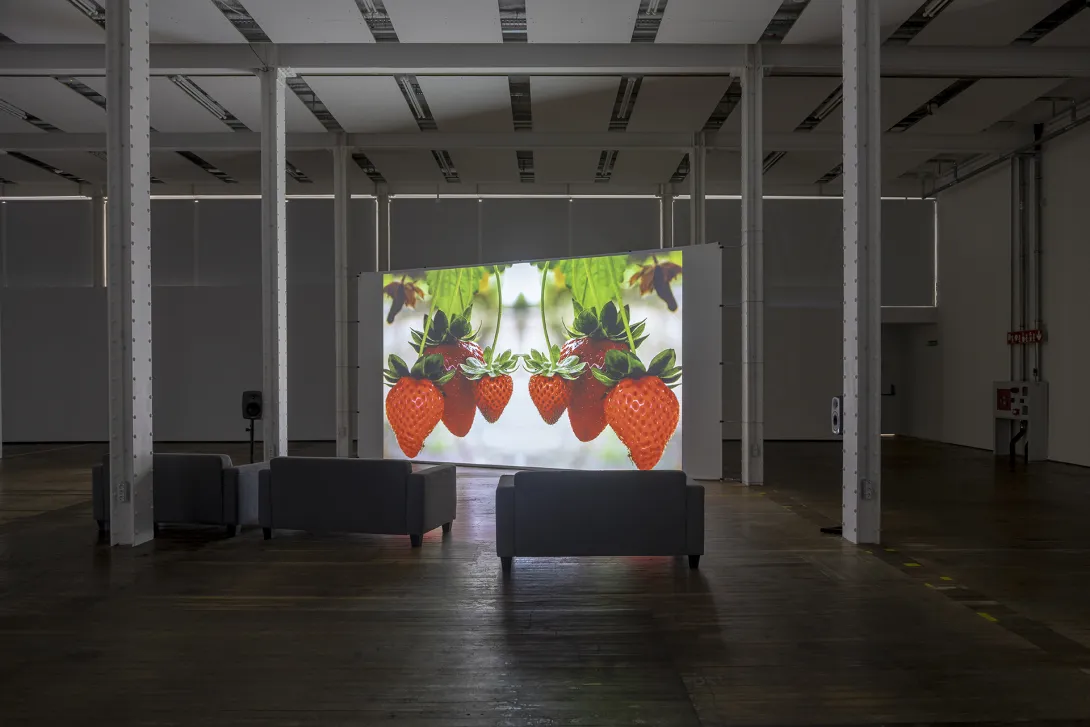
Strawberry Fields explores the figure of seasonal women workers and the problems arising from intensive agriculture, establishing a continuity between our colonial past and the current extractivist regime. The film, situated between visual essay, documentary, and experimental video and cinema practices, is a journey through the physical and human landscapes of strawberry cultivation in the region of Huelva.
65-minute looped projection
The video creation by Julia Montilla is the winning project of the 11th edition of the Video Creation Award. A co-production of the video creation project between the Regional Centres of the System of Public Visual Arts Facilities of Catalonia,* Santa Mònica, the Generalitat de Catalunya’s Department of Culture and LOOP Barcelona. This exhibition is part of the Loop Barcelona festival.
Strawberry Fields explores the figure of female seasonal workers and the issues that arise from intensive agriculture, establishing a continuity between our colonial past and the current extractivist regime. The film, which encompasses visual essay, documentary and experimental video and film practices, references the song by The Beatles of the same name in its title. The song —a lysergic, psychedelic story, written in Almeria— alludes to the perception of reality (“nothing is real”), exploring the idea that life is simpler when we close our eyes to our surroundings (“living is easy with eyes closed”). However, seeing is a political act. What we see, we affect and, at the same time, we are affected by what we see, which is why this reference mentions both voluntary avoidance and the established view of the world. Two positions that determine the lack of visibility of female day labourers. Following this theme, some of the issues that the film addresses are the factors that have led to the absence of visual representations of these workers and how the dominant culture has constructed their image.
Strawberry Fields is, in part, a hallucinatory and kaleidoscopic journey through the physical and human landscapes of strawberry cultivation in the region of Huelva, which explores the subjective and political nature of the film apparatus and breaks the reality effect of the device. The film project aims to create a critical space for current forms of colonialism and ecocide through audiovisual language, aligning with the principles of representational intersectionality, a tool for resilience and the interruption of dominant narratives about subordinate subjects.
Julia Montilla (Barcelona, 1970) graduated in Fine Arts from Universitat de Barcelona (UB), where she is currently working as an associate professor and studying her PhD. Montilla is part of the Spanish R&D&I project Ritmos del trabajo femenino en la historia del arte y la cultura visual, 1936-2022 (Rhythms of Female Work in the History of Art and Visual Culture). Using a multitude of means, she analyses the role of images and the visual construction of everyday life. Over the past decade, she has developed productions relating to mental distress, religious ecstasy and job insecurity and exclusion. Since the late 1990s, her work has been exhibited at venues such as La Capella and Espai 13 at Fundació Joan Miró, in Barcelona, Centro de Arte Dos de Mayo in Madrid, MACBA in Barcelona and Museo de Arte Contemporáneo de Castilla y León. She has been awarded grants by institutions such as MoMA, Fundación Botín, Fundació ”la Caixa” and the Institut de Cultura de Barcelona. She was a trustee on the board of Hangar, has worked on the Hamaca Experimental Audiovisual Platform and founded the bookshop La caníbal.
* The regional centres of the System of Public Visual Arts Facilities of Catalonia are: ACVIC Centre d’Arts Contemporànies (Vic); Bòlit, Centre d’Art Contemporani (Girona); La Fabra Centre d’Art Contemporani (Barcelona); M|A|C Mataró Art Contemporani (Mataró); Mèdol – Centre d’Arts Contemporànies de Tarragona (Tarragona); Centre d’Art la Panera (Lleida); Lo Pati Centre d’Art – Terres de l’Ebre (Amposta); and Centre d’Art Tecla Sala (L’Hospitalet de Llobregat).
** This video projection includes flashing lights and strong visual patterns, which may affect photosensitive individuals. Visitors are advised to exercise caution.