
Ciutat Vella to reduce activities in streets and squares
The district is updating its authorisation criteria to promote local actions and take the strain off spaces occupied by events. A set of measures will be developed to take into account during the authorisation process, bearing in mind the return for the local area, and prioritising activities that favour social and cultural vitality and economic promotion.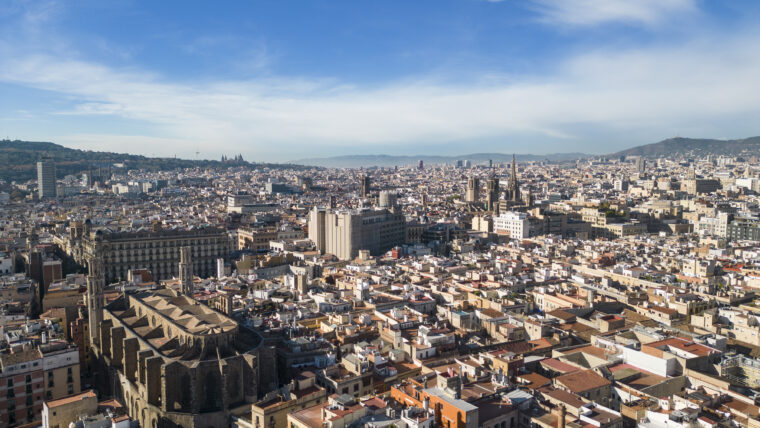 Views of Ciutat Vella from Santa Maria del Mar looking west
The new regulation responds to demands and concerns among local organisations and residents within the context of the participatory process of the Pacte per Ciutat Vella, and looks to balance public space between preservation and promotion.
Priority will be given to district events ahead of central ones, reducing the volume of the latter held in iconic spaces. At the same time, protected spaces will be created for spaces that require limits on capacity, infrastructures and sound.
This will be the case for the following locations: Plaça del Rei, Pl. Mercè, Pl. Duc de Medinacelli, Pl. Vila de Madrid, Hort de la Bomba, Plaça Hilari Salvadó, Pl. Sant Just, Pla de Palau, Pl. Sant Jaume, C/ Carme Simó, C/ Pintor Fortuny, Placeta Martina Castells, Plaça Terenci Moix, Plaça dels Àngels, Avinguda de la Catedral, Passeig de Lluis Companys, Passeig del Born, La Rambla and the Parc de la Ciutadella.
The biggest reduction is intended for Passeig de Lluís Companys, to reach a maximum number of 25 events a year.
New criteria
Authorisations will have to take into consideration whether the proposed space is suitable for the activity, depending on its dimensions, the noise impact and the chosen site. The measure also looks to improve transparency and equal opportunities. The main goals when authorising activities and events in public streets and squares are:
- Guaranteeing the well-being of local residents, in terms of hours of rest and mobility.
- Strengthening associations and culture in the neighbourhoods.
- Adding vitality and giving support to shops and business, small local commerce and restaurants.
- Consolidating the factor of historical and political centre.
Consideration will be given to activities of general interest, open participation, the promotion of education, culture and sport; awareness relating to health, the environment, housing and sustainable mobility; gender equality, protecting children, functional diversity and sexual diversity and more. In addition, organisers will not be able to accumulate infringements from previous activities.
Special measures
The update to the regulations will include a criterion to draft a plan of measures to protect people against high temperatures, bearing in mind aspects such as shade, limits on central activities, the inclusion of pauses for drinking water etc. The possibility of suspending activities in the case of red alerts for very high temperatures will also be added.
Conditions on times will also be established to limit the maximum duration of music to six hours, plus an obligatory silent period from 2.30 pm to 4.30 pm, and a maximum of two consecutive days of activity at night involving sound in the same place etc.
The district handled nearly 2,000 events occupying public space in 2024, an average of 5.4 a day, which generated an approximate cost of some 800,000 euros in infrastructure provided by Barcelona City Council. On top of these figures, there was also a total of 429 demonstrations and concentrations in 2024.
Tags associated with the news item
Related news
-
 City Council
City Council
City CouncilThe Advisory Council of the Ciutat Vella Agreement has been established
30/10/2024 14:02 h
