Barcelona will host the headquarters of the Fraunhofer CAT project, a center specializing in bioengineering and advanced therapies
The new hub will be a first-rate complex in Southern Europe and will position Barcelona as a city of reference and innovation on the continent.
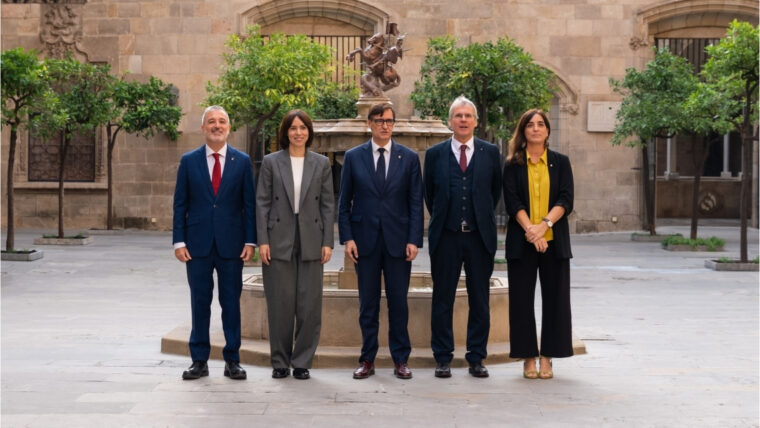
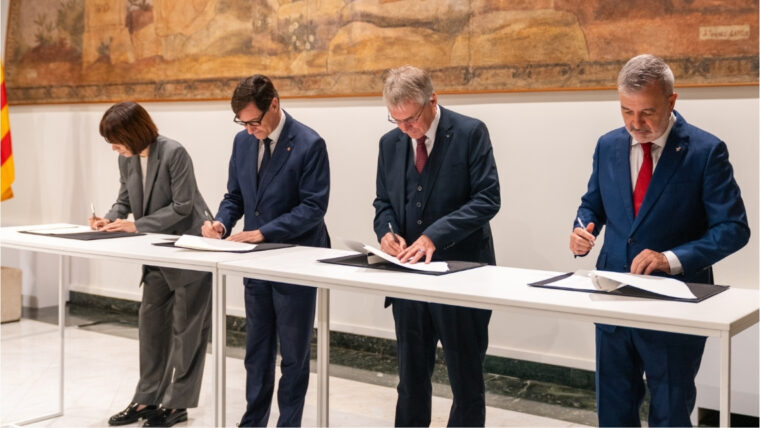
The governments of Catalonia, the State, the Barcelona City Council and the Fraunhofer Institute (Fraunhofer-Gesellschaft) have this morning sealed their commitment to deploy the Fraunhofer Center for Applied Theragnosy, called Fraunhofer CAT. This new hub specialized in advanced therapies in the field of health will be installed in Barcelona and will operate under the umbrella of the Fraunhofer Foundation Spain.
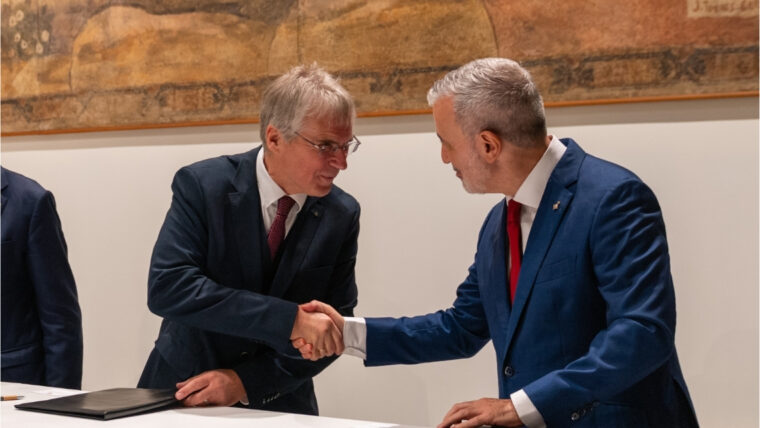
The institutional agreement was signed at the Palau de la Generalitat by President Salvador Illa, the Minister of Science, Innovation and Universities, Diana Morant, the Mayor of Barcelona, Jaume Collboni, and the President of the Fraunhofer-Gesellschaft, Holger Hanselka. The four institutions will cooperate in the long term to guarantee the implementation, international projection and sustainability of the Fraunhofer CAT project.
The new initiative will receive global funding of 25.5 million euros until 2031. Of this total amount, the Generalitat, through the Department de Recerca i Universitats, will contribute 14 million euros, the Ministry of Science, Innovation and Universities 4,5 million and Barcelona City Council 8 million.
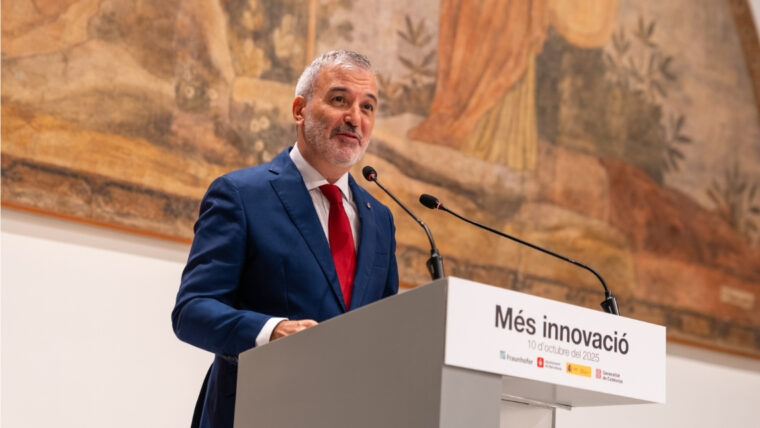
Mayor Jaume Collboni highlighted during his speech that the launch of Fraunhofer CAT “will involve a leap in scale in our innovation ecosystem. Making a leap from science to knowledge transfer.”
The mayor explained that “this project will allow us to live better in Barcelona. With new technologies to improve health, with more competitive companies that generate more wealth, and with more and better jobs for the people of Barcelona.” He also noted that “it is a project with an undoubted European dimension” and placed it “at a time when anti-scientific discourses and denialism are growing, the city of Barcelona is reinforcing its commitment to science.”
A reference in southern Europe
This shared effort demonstrates the common desire to consolidate Barcelona and Catalonia as European benchmarks in applied research and biomedical innovation. In fact, the Fraunhofer CAT will become the first hub on the continent specialized in theragnosis, a patient management strategy that involves the integration of diagnosis and therapy, to advance towards personalized medicine.
The new center arises from the collaboration between IBEC (Institute for Bioengineering of Catalonia) and the Fraunhofer Institute for Biomedical Engineering (IBMT) and will be directed by IBEC professor and director Josep Samitier. Its most basic objective will be to develop innovative technologies that help with diagnosis, prognosis and selection of therapies. In this sense, it will act as a bridge between research laboratories, clinics and industry, insisting especially on the transfer of knowledge and accelerating the translation of scientific results into cutting-edge medical solutions.
Among other applications, it will work on organs on a chip and organoids, to model diseases and accelerate experiments for new drugs, on cell therapies, 3D bioprinting for precision medicine, or on microfluidic and nanotechnology systems to encapsulate drugs, cells or DNA.
The new institution will combine IBEC’s strengths in bioengineering, biosensors and biomimetic systems for biomedical applications with IBMT’s expertise in stem cell process technology and cell-based microsystems. It will allow, among other things, to attract scientific talent, internationalize the Catalan biomedical sector and position Barcelona as a European benchmark in the field of medical bioengineering.
Fraunhofer-Gesellschaft
The Fraunhofer-Gesellschaft, founded in 1949, is the largest European research institution. It is under the German Federal Ministry of Research and Education and comprises 75 research centers and groups throughout Germany and 16 locations in other countries. It employs more than 32.000 people and has an annual budget of 3,6 billion euros, coming from the public and private sectors.
Its activity is focused on applied research, and it works in fields as diverse as biomedical engineering, industrial mathematics, transport, optics and construction physics.
The institute, apart from the new Fraunhofer Foundation Spain, maintains alliances on the European continent with centers in Austria, Italy, Sweden, Portugal and the United Kingdom.