
Blanca Pujals: “Research is deeply conditioned by political, material and social realities”
As a multidisciplinary researcher and artist, Blanca Pujals defines the keys to her artistic work, with an international presence and in events such as the recent City and Science Biennial, organized between 18 and 23 November, 2025, by the Barcelona City Council.
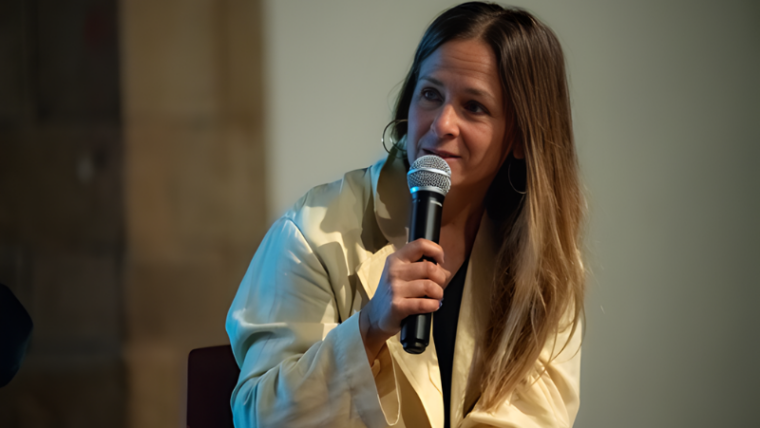
With a degree in architecture (UPC), a master’s degree in Critical Theory and Museology (MACBA), and a doctorate with the project “Sensing Infrastructures: A spatial examination of soft power, the neutrino particle and the underground laboratories of fundamental physics” (2024), Blanca Pujals defines herself as an architect, filmmaker and doctor in Philosophy, Visual and Material Cultures. She is part of the international working group DMAMCM (Dark Matter-Anti Matter-Condensed Mater), a collective study that investigates how the concepts of quantum physics and conceptual mathematics can help us think about politics and sociality. His projects have traveled through Europe, the United Kingdom, the United States, Switzerland, Colombia and Antarctica.
Blanca, welcome. We have seen you very active this year, in events such as the City and Science Biennial (November 18-23). In your work physics, philosophy, architecture and art are intertwined. How do you understand this encounter between disciplines and how did you transfer it to the Biennial?
To put a concept of physics, diffraction, as proposed by authors such as Donna Haraway and Karen River Barad, implies the possibility of understanding different practices through each other, producing results that emerge from narratives or languages that, a priori, would be considered different. The separation of practices, in what are usually called categories or disciplines, is a fairly recent separation, perhaps more relative to a utilitarian vision than real, since practices constantly intersect and interfere, and not thinking of them as separate offers us the opportunity to see how differences and links between them are generated, and what particular effects they produce.
You have developed a career that crosses architecture, critical thinking and visual research. Could you tell us more about your practice and how does it connect with the contemporary techno-scientific infrastructures that you investigate?
My spatial research is articulated in narrative, textual and audiovisual formats to analyze the material and political processes that sustain contemporary techno-scientific infrastructures. I am interested in infrastructure understood as a set of socio-technical and ecological systems that organize life, and that often remain invisible until they break or until we pay attention to the work, also invisible, that maintains them. In the field of particle physics, I study how fundamental knowledge materializes in underground laboratories that function as infrastructures in themselves. These spaces not only observe the origin of the universe, but also transform territories, resources and transnational political relations. My perspective from architecture and politics focuses precisely on this double dimension: the scientific and the territorial.
Your doctoral and audiovisual project, Quantum Sensing Infrastructures, takes us into the world of theoretical and experimental physics. What sparked your interest in these invisible spaces and what is your reading of them from the point of view of architecture and politics?
The project was born from a fascination with the neutrino, an almost immaterial particle that can only be detected in underground laboratories equipped with very sensitive sensors. These spaces, often inserted in mountains, ice or bodies of water, function as “architectures for spectral matter”, where ancient geologies and extremophile ecosystems are found.
Following their traces has led me to remote landscapes and underground infrastructures that demonstrate the geopolitical dimension of fundamental science. Despite their neutral appearance, these laboratories transform territories, involve large energy consumption and are part of international networks and treaties.
Spaces such as CERN, Antarctica or Canfranc show how fundamental research participates in processes of diplomacy and soft power, projecting political and energy logics into the subsoil and generating ecological and cultural effects in places that are often remote or in dispute.
You are a member of the international collective DMAMCM where you work to think about how quantum physics can inspire new forms of socialization and politics with figures like Karen River Barad or Denise Ferreira da Silva. What has this experience brought you and what ideas have been particularly inspiring to you? Which ones do you think are most relevant for society?
Being part of the DMAMCM (Dark Matter-Anti-matter-Condensed Matter) collective has been very enriching because it allows us to approach quantum physics from a political and social perspective. The group questions categories such as causality, agency or space, and rethinks them based on quantum concepts. Karen Barad’s notion of intra-action, according to which entities do not exist before relating, but rather co-constitute each other, opens up ways of imagining more interdependent forms of sociality. Also key is Denise Ferreira da Silva’s idea of “difference without separability”, inspired by non-locality, which allows us to think about difference without fixed borders.
Likewise, the reinterpretation of the quantum void as a space full of activity, which authors such as Barad or Fred Moten work on, serves to think about the invisibility of certain bodies and communities. Taken together, all these contributions offer new tools to rethink coexistence and the social structures that shape our world.
How can this combination of hard science and philosophical thought, be communicated or translated to a non-specialized audience without losing its complexity?
I have approached quantum physics from a spatial and material perspective, reading it through the infrastructures that make it possible. This approach shows that fundamental science is not neutral, but is inscribed in territorial, energetic and political networks. That is why I also work with filmic and literary narratives, which help to make the abstract tangible.
Since 2016 I have been researching the neutrino, the “ghost particle”, and its imagery led me to develop the concept of “quantum horror” in the GRAPA project, in dialogue with researchers from IFAE. This line has opened up new ways of thinking about research and the abyss of the unknown that particle physics implies. During the project I also made particle detections in the Cardona Salt Mine and in the Barcelona subsoil, to show that particle physics is not exclusive to large laboratories: the matter it studies is present everywhere and can be explored from much closer contexts.
You have presented projects to institutions all over the world, from London to Ljubljana, including Barcelona. What do you think spaces like the City and Science Biennial can contribute to this international debate between art, science and society?
Barcelona is an interesting context for existing scientific centers and research, which also collaborate with international centers and research – such as CERN in the case of particle physics – and a community of artists and spaces, such as Hangar or the CCCB, which have been working at these intersections for years. Events like the Biennial City and Science can continue to make visible and continue to generate encounters so that different scientific, artistic and social practices can meet outside their usual spaces.
Finally, if you had to imagine the science of the future, a more democratic, sensitive and connected science to the planet, how would you visualize it?
After years of working with fundamental science physicists, I do not believe that they are disconnected from the world. Although their research is abstract, it is deeply conditioned by political, material and social realities. Often, the distance does not come from the scientists, but from the economic, political and ideological structures that regulate how knowledge is produced and circulated.
Public funding does not automatically guarantee a more democratic science either, since it also responds to geopolitical strategies. The challenge is to think about who we do science for and for what purpose. In the future, I would like research that is not absorbed by transhumanist or technoutopian narratives, but rather maintains a critical view of its material, ethical, ecological and social implications.