
Jara Juana Bermejo-Vega: “Pole dancing can be a powerful tool to explain quantum physics and claim diversity in science”
Quantum computing researcher and inclusion activist, Jara Juana Bermejo-Vega combines research and artistic expression in a proposal that is as surprising as it is meaningful: explaining concepts of quantum physics through pole dancing. A doctorate in physics, with an international career and currently a Ramón y Cajal researcher at the University of Granada, Bermejo arrives at the 4th Biennial City and Science with a performance that unites science, art and claim. The show, created jointly with a team of physicists and dancers, is a piece that celebrates both the International Year of Quantum Science and Technology and Science Pride Day, putting the body, knowledge and diversity at the center of the stage.
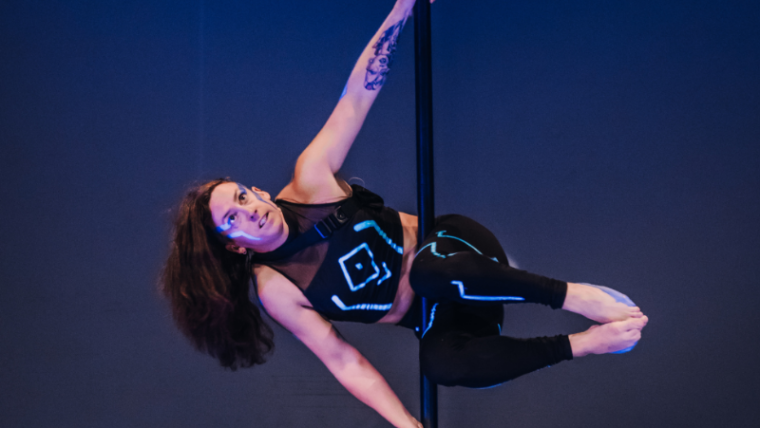
Juani, first of all welcome. You are one of the participants in the 4th Biennial City and Science, which takes place between November 18 and 23 with its epicenter in El Born. Barcelona History Museum. From what we have seen in the program, you bring us a very interesting proposal, tell us what your role will be and how important it is for you to take part in it?
Thank you very much, it is a pleasure. We will present a piece that combines outreach and dance, where we explain concepts of quantum physics through pole dancing. The work addresses topics such as multi-body physics and we do it with a team of colleagues whom I greatly admire: Noelia Sánchez Gómez, Sandra Sánchez Canelas and María del Carmen Guillén, from the PoleFitness Granada gym, with the support of the Barcelona pole dancer Cristina Dezi. We want to bring quantum to everyone through a dissident artistic discipline that has roots in marginalized communities. In addition, the performance coincides with two symbolic moments: the celebration of the International Year of Quantum Science and Technology and Pride in Science Day, on November 18, a very significant date for queer scientists.
How did the proposal for the pole dance show that you will show us at the Biennial come about?
Noelia and I met as pole dance students with our teacher —and “pole mother”— Sandra Sánchez at the Pole Fitness Granada gym. We are both physicists and today we are colleagues both in the UGR research group and on stage.
One day at the gym we mentioned that we would like to combine physics and pole dance. What started as a crazy idea became a talk at the Desgranando Ciencia 2023 festival, and then a show called Mecánica clásica en barra, under the name Dipole Magnético. Later, they proposed that we create a quantum version of it, coinciding with the International Year of Quantum Science and Technology. This allowed us to expand the project, incorporate more artists, like Sandra, and work on visual and lighting aspects to represent quantum phenomena. We have also collaborated with pole dancer and artist Cristina Dezi, from Barcelona, to investigate the relationship between light and movement, and with our partner Meri, who provides technical support. The result is a show that connects science and art, and which for us is also very familiar and emotional.
You share this Biennial with one of the world’s leading figures in quantum physics, Juan Ignacio Cirac from Manresa, director of the theoretical division of the Max Planck Institute. He was your supervisor during your PhD: how do you value this collaboration?
Ignacio founded one of the world’s leading groups in quantum information theory. It was a fundamental stage in my career. In Cirac’s group at Max Planck, I had the opportunity to train in a very stimulating environment, surrounded by experts in quantum computing and optics and condensed matter. Those years allowed me to acquire a solid foundation to grow as an independent researcher.
Your research focuses on quantum computing and you are currently developing it with a Ramón y Cajal grant. Could you explain to us what it consists of, in a way that is understandable to everyone, and what your day-to-day life as a researcher is like?
After a period as a Marie Curie fellow, I am now a Ramón y Cajal researcher and I direct several national and international projects, such as a Consolidation grant and a HORIZON RIA project. The aim is to explore new forms of computing that use microscopic phenomena to optimize computer processes.
These grants have allowed me to form a research group in quantum computing at the University of Granada, made up of highly motivated young researchers. It has not been easy: I returned to Spain in the midst of a pandemic and at a complicated time, also marked by transphobic discourses that affect the daily lives of many people. But today I can say that we work with enthusiasm and with the conviction that science can also be a fairer and more diverse space.
You often talk about the importance of ‘coherence’ in quantum computing. How could we explain it in a way that is understandable to someone without a technical background?
I like to explain coherence as the opposite of incoherence, which is what happens in a conversation with friends in clubs when the music is very loud, there is noise and a lot of sugary drinks: you don’t appreciate a damn of the nuances of the conversation. However, when this noise is removed, the conversations are richer and more coherent. Quantum coherence is a state of microscopic systems, atoms, photons, particles, which in the absence of ambient noise manifest new types of physical phenomena, which often hide the noise. Nowadays the ambient noise of quantum systems can be reduced in a controlled manner in laboratories, and it allows us to observe effects of great fundamental importance, as well as technological applications. The laser, for example, is coherent light, created through a process of quantum amplification and stimulation.
In quantum mechanics, and especially in computing, one of the keys to understanding how things work and the advances that occur is superposition. How can we understand the term in a simpler way?
Superposition is the ability of a quantum system to be in several states at the same time. We can imagine it as a wave that bifurcates and interferes with itself, creating complex patterns like in a pond. Algorithm designers for quantum computers take advantage of these simultaneous states to solve problems more efficiently. It is one of the most beautiful and fascinating concepts in modern physics.
“Supercomputing” is progressing by leaps and bounds. We can see, especially in Barcelona, the magnitude of projects such as Qilimanjaro, or centers such as the Barcelona Supercomputing Center. What practical applications does all this have and what are the steps that need to come?
Currently, the most consolidated applications of quantum computers are scientific simulations, which help us better understand the behavior of matter at a microscopic level. There is also a lot of research into artificial intelligence and optimization, although it is still too early to know how far they will go. If we manage to overcome current technical limitations, these technologies could transform many areas of science and industry.
When we think of quantum supercomputing, it often sounds distant or futuristic, even though this year marks the 100th anniversary of quantum science. What areas of everyday life could be transformed first?
One of the areas where it could have the greatest impact is in digital security. Quantum computers could break current cryptographic systems, such as the HTTPS protocol, and this will force the development of new methods of data protection. It is likely that in the future, these computers will be integrated into supercomputers as calculation accelerators, similar to what GPUs do today.
Juani Bermejo is also known for her activism. In 2019, you decided to make your gender identity public, an important step that you explained openly and that is not always easy in professional environments. What difficulties or challenges have you encountered on this path?
Being a computer scientist and a woman is hard, also being a trans woman, you have to face social inequalities, and forms of oppression such as transmisogyny. It is common to find yourself burdened with lower-paid or less desirable jobs. Your work is valued less, you are considered less capable or competent, or your work is not appreciated. We also experience harassment more frequently, which has happened to me in my personal life and at work, after transitioning. Not to mention that a coworker, for example, stole my results. Despite the problems, transitioning has led me to live as who I am and has made me happier than ever.
Currently, 90% of quantum computer scientists in the world are male, white and heterosexual. What does science lack to be more diverse, inclusive and tolerant? Any suggestions?
There are still many structural inequalities that we see in everyday life, such as misogyny, racism, or transphobia. Science is not a safe space, even if we sometimes think it is. It is a very hierarchical system and situations occur that favor harassment. There is no need to give up, despite everything, society for oppressed people, queer people, women, or the disabled is a little easier every day thanks to our struggle and social demands.
Your role as an activist in this field is outstanding. You co-founded, among other things, the Q-Turn project, a series of annual conferences that include different profiles within the field of quantum mechanics. How do they work and when will the 2026 edition be held?
These networks are collectives that we created to claim the rights of oppressed people within the scientific world. The Equal Opportunities Group was born with the aim of promoting fairer conditions for everyone within the Max Planck Institute network in Germany, and was founded by a group of doctoral students from that community. It became a real refuge for many researchers who needed a network and a community that also took care of the human problems that research faces.
Later, as a postdoctoral researcher, I co-founded Q-Turn, a congress and association dedicated to promoting a fairer and more conscious quantum science. We proposed a hybrid format that combined talks on social reflection with the scientific program of the congress. The project is currently on pause, I had to stop it during my transition and motherhood process, but we are looking for the opportunity to reactivate it.
What message would you give to the new generations of students who want to enter the world of quantum and who may not see themselves represented in the current majority profile?
I would tell them not to settle or accept spaces that make them feel small or invisible. To look for places where they can grow, be happy and feel free. Science needs diverse and brave minds. Chasing dreams and living with pride is a form of resistance and also a way to transform the future, and never forget your pride.