
Mateo Valero "The BSC is a leading infraestructura that promotes and multiplies the science that is produced around it"
As founder and still director of the BSC (Barcelona Supercomputing Center-Centro Nacional de Supercomputación), Mateo Valer can explain with perspective the exponential evolution that the institution he leads, which has already celebrated its 20th anniversary, has experienced.
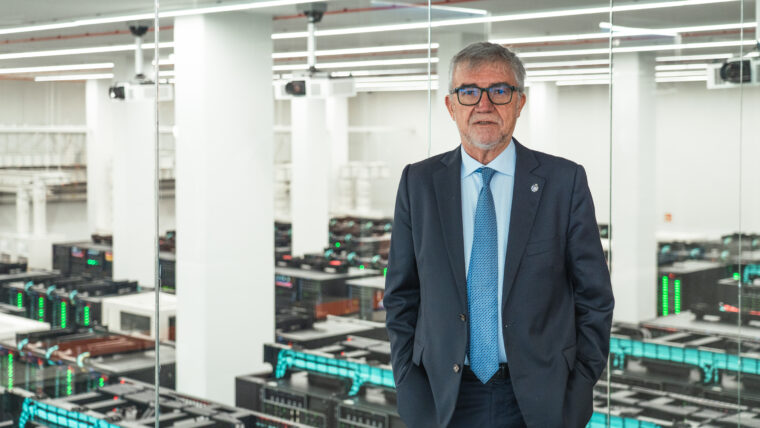
Mateo Valero, who graduated in telecommunications engineering (Madrid, 1974), moved to Barcelona and obtained his doctorate at the UPC in 1980. He remained associated with this university and began working in his field, computational architecture. Since then, he has published more than 700 scientific articles, received multiple awards, including the Creu de Sant Jordi (in 2016) and promoted different leading projects. In 1985, he proposed to the Ministry of Industry to create a new institution to progress in this field, and from this impetus the CEPBA (the European Center for Parallelism of Barcelona) was born, which he went on to direct, and which represents the most immediate predecessor of the BSC.
Your research area is computational architecture. How could you explain what it is so that everyone can understand it?
It refers to the design of new tools and new technologies within the computer field. I did my thesis on local networks, but what I really liked was computer design. I was very lucky to be hired very early on to be part of the computer architecture research group at the UPC. The person in charge left and left me in charge. We worked on “architecture design”, and we investigated how we could improve the performance of various computers with high-speed processors. We were already aware at that time that a lot of work was needed to be able to evolve and we didn’t even think we would get to where we are today.
You then created and directed (between 1995 and 2000) the Catalan Center for Computing and Communications, which coordinated the activities of the European Center for Parallelism in Barcelona and the Supercomputing Center of Catalonia. Can it be considered the most immediate predecessor of the BSC?
Everything was a progression. In the 1980s, we saw how machines were beginning to be created that incorporated several high-speed processors, what is known as parallelism. As a result, I asked Joan Majó, Minister of Industry and Energy (1985-1986), to grant us some money, 10 million pesetas, to set up a new parallel computer research center. With this funding, we opened the CEPBA (the European Center for Parallelism in Barcelona), in 1985, which functioned as a nucleus within the university, without its own NIF, and always depended on the vice-rector. To give you an idea, it was like the BSC but with much smaller machines, which were about 100 times slower than the first version of MareNostrum (2005).
In 2004, an agreement was signed between the Spanish government’s Ministry of Science, Innovation and Universities, the Generalitat of Catalonia and the UPC to expand the European Centre for Parallel Computing in Barcelona and create the Barcelona Supercomputing Center. How did you get involved and what were the first steps?
They were the ones from Madrid who started proposing it. They said they had money and wanted to do something bigger. I was in contact, precisely, with the IBM company, thinking about how future computers could be made. We went to talk to the Generalitat and they told us that they wanted to bet on it and contribute half of the investment. Finally, shared financing was agreed: the Ministry would put in 65% and the Government of Catalonia 35%. As a great curiosity, the agreement to seal the purchase of the MareNostrum 1 supercomputer was closed just a few hours before the attack that hit the Atocha station (March 10, 2004) in Madrid. If we had waited one more day we would have been left without the machine!
In its twenty years of history, the institution, located in Torre Girona (in the district of Les Corts), has gone from having only 65 employees to having more than 1.300. What would you say the growth of the BSC has meant for Barcelona?
It has expanded the research ecosystem around it. The BSC is a public center, and therefore has a duty to give back what it receives. Being located in Barcelona is a “win-win”. The city has a perfect ecosystem, and the center is a leading infrastructure that promotes and multiplies the science that is produced around it. It has created many jobs, has contributed a lot of investment and, at each event it carries out, it attracts people who leave a lot of money in the city. We are the third largest institution in Spain, only behind Tecnalia and the CSIC, and one of the most cutting-edge centers on an international scale. I honestly never imagined we would grow so much!
MareNostrum. This is the name given to the supercomputer that forms the core of the BSC. It has gone through 5 versions, or new updates, in 2006, 2013, 2017 and the last one, in December 2023, with the inauguration of MareNostrum 5. It has a performance 18 times higher than its predecessor, MareNostrum 4, and a processing capacity of 314.000 trillion operations per second. These are figures that escape us… To be clear: how does it work and what does it mean for science?
It is about connecting two issues: processing, with increasingly smaller and more powerful chips, and enormous storage. To understand ourselves, and to understand how everything has evolved, the current MareNostrum 5 is 10.000 times more powerful than MareNostrum 1, the first version. It works, basically, by connecting many processors at high speed. It is a gigantic tool and is at the service of science, of any research that requires a lot of data. To make a comparison it would be like the discovery of Humphry Davy (1778 – 1829), the British who introduced electrolysis, the system that serves to separate the elements within a compound using electricity. It is not an end in itself but rather it is a powerful structure for making new discoveries.
And that wasn’t enough. Last February, the BSC presented the first quantum supercomputer in the state. It will operate in parallel with MareNostrum, and is a project within the Quantum Spain initiative, promoted by the Ministry for Digital Transformation and the Public Service. What are the differences between it and a classical supercomputer?
The difference is the system. Classical transistors only work in a pair of positions, 0 or 1 (allowing or not the flow of electricity). In quantum, however, this bit system is transformed into that of Qbits, there are 0 and 1 but also superposition. All this should allow much greater speed, but for the moment quantum machines are still in their infancy, and in the hands of private investors. Our quantum computer has been installed in the Capella (which had been the location of the first four versions of MareNostrum). Behind it, another one must be built with new European material. This technology, while it is starting up, is combined with that of classical supercomputing, and means that where one cannot reach, the other can reach.
All this infrastructure is open to the use of companies, institutions and research organizations. It can allow progress in research but also to position itself within the commercial field. How are these collaborations made?
This line, more of help or service to companies, is enhanced above all with artificial intelligence. For example, a company dedicated to selling clothes can calculate precisely what the weather will be like in March and adapt its line to increase its sales. But we are a research center, we cannot lose our DNA, and we must prioritize this aspect first. On the other hand, and as for the other researchers, there is an independent committee that evaluates the projects that are presented, by competitive competition. Those who win the contest use the infrastructure, for their calculations and studies, remotely.
As an example, some of the research projects that are progressing with this infrastructure are in the field of life sciences. Diagnoses, or systems to search for new treatments, can be much more accurate. Can we say that we have already jumped to personalized medicine?
Absolutely, everything that has already been achieved is fascinating, it is the field that interests me the most, because it has a direct and clear social return. We work with hospitals and research centers in this aspect. Through what we designate as “digital twins”, which in short is the new technology that allows us to make a virtual copy of a material or tissue with which we want to research, we can test medicines or innovative treatments, and complement, for example, with mini-organ systems, with which we can refine by extracting the cell line of the patient we want to cure. Personalization in medicine is already a fact, we are promoting it 100% and the advances that may occur in the future are expected to be exponential.
The center works especially on the design of semiconductors, the main elements of chips for computing, mobile telephony, vehicles and new medical technologies. Can you describe to us what the European Chip project is and what potential there is in Barcelona in this area?
It is a very complex issue that is currently dominating the world in terms of geopolitics. And it is also my specialty and devotion. These chips are made with silicon, but there is an increasing search for ways to make them smaller and more precise to increase their performance and efficiency, and for this reason, other materials such as graphene are also being investigated. The fact is that manufacturing them is not easy, they require scarcer substances, and a large infrastructure and investment. For this reason, the factories are in the hands of a few countries (the United States and Taiwan, basically) and we dedicate ourselves to designing their software (the commands with which they will have to operate). The European Chip project designs open-source chips, which allow simultaneous entry of different programs, priorities and approaches. Barcelona and Catalonia present a favorable ecosystem in this regard, and there are already many companies around this issue. The intention is to grow further. But what will be complicated is making Europe self-sufficient in the manufacture of these small devices.
What new steps await the BSC if we look at the short and long term?
For now, continue growing and promoting this whole world of research, especially our own, as a research center, but obviously, serving others, because we are a public center, and we receive money from everyone. The short-term ambition is to be able to have a much greater impact on small and medium-sized companies, transferring knowledge and granting them the benefits that supercomputing allows. And insist on artificial intelligence, to be able to be even stronger in this field, in the design of small chips, and in research aimed at medicine, climate predictions, and new technologies for defense. And as for the infrastructure, the materials are advancing rapidly and soon our MareNostrum 5 will become MareNostrum 6, and it will allow us to accelerate even more this dense research ecosystem that we have in Barcelona.