
“Organizing an event of this magnitude demonstrates the city’s capacity to generate interest and attract talent”
We speak with the three curators of the 4th edition of the City and Science Biennial to be held in Barcelona between November 18 and 23.
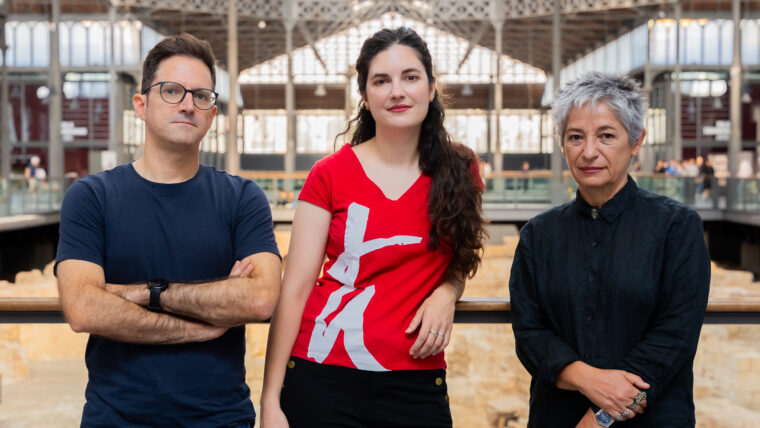
ALBA CERVERA
Alba Cervera is a senior researcher at the Barcelona Supercomputing Center (BSC-CNS) and coordinator of the Quantum Spain project, which promotes the quantum computing ecosystem in Spain. A PhD in quantum information, her research focuses on quantum computing and the synergies between quantum physics and artificial intelligence.
TONI POU
Toni Pou is a physicist and science writer, co-director of the Postgraduate Program in Scientific Communication at the University of Vic and co-founder of the Eduscopi agency. He has been responsible for the science supplement of the newspaper ARA and collaborates with various media. He has curated cultural and scientific projects and is the author of several popular books and a novel on scientific themes.
HACTE. Barcelona Hub of Art, Science and Technology.
HacTe is an association created in 2022 and formed by eleven entities from the academic, cultural, scientific, technological and industrial fields, directed by Tere Badia. From HacTe, a specific working group on quantum is promoted, led by Lydia Sanmartí (ICFO) with the participation of institutions such as the UOC, UPF, UPC, IFAE-BIST, Hangar and the New Art Foundation.
The City and Science Biennial is getting bigger. With this year’s celebration (which will take place between November 18 and 23), it has reached its fourth edition and is now established as a major event in Barcelona. To what extent would you say it has contributed to bringing scientific concepts and cutting-edge research closer to citizens?
Tere Badia: Spaces like the Biennial are essential. We are living in a time where there is a great distortion of scientific reality and a certain collective vulnerability to disinformation. That is why it is so important to create spaces for affirmation, dissemination and knowledge open to society.
Alba Cervera: The aim is to bring seemingly complex concepts, such as quantum physics, closer to everyone. The Biennial is an opportunity to publicize the research being done in the city and to arouse curiosity. When science becomes accessible, people get involved and ask more questions.
Toni Pou: In the last edition, more than 12.000 people participated. This shows that there is a growing interest in science. But it is also a responsibility: research is done with public resources and we have to explain what we do. In a world dominated by technology and frontier science, we need informed citizens with critical thinking.
Barcelona is gaining importance as a scientific and cultural capital. What role can the Biennial play in reinforcing this image on an international scale?
Alba Cervera: Barcelona is a very strong point of attraction in terms of research, not only in areas such as robotics, but also in many other fields. Organizing an event of this magnitude, with the participation of experts from all over the world, demonstrates the city’s capacity to generate interest and attract talent. In the case of quantum research, Barcelona is a benchmark, and the Biennial is a window that projects this reality to the world.
Tere Badia (HacTe): What makes the Barcelona fabric unique is the confluence of science and artistic research. There are very few territories where this collaboration is so constant and profound. Centers like the Barcelona Supercomputing Center or the ICFO have been working with artists for years, and there are even institutions like the Institute of High Energy Physics or the Center for Genomic Regulation that incorporate creators into their projects. In other words, this fabric of how science and the arts and these knowledge systems intersect, I believe that it is unique here and the academy is not just a space to make it public and show it.
This year’s event focuses on one main theme: quantum mechanics. It is taking place within the framework of the International Year of Quantum Science and Technology, declared by UNESCO. What challenges and opportunities does an apparently complex discipline present when explaining it to a non-specialized audience?
Alba Cervera: The first challenge when we talk about quantum is to undo the mysticism that surrounds this word. It is often associated with something very complicated or unattainable, but the reality is that quantum physics has been part of our daily lives for years. With the Biennial we want to break with this perception and show how its impact is very real. The round tables and interdisciplinary activities, which will address quantum from geopolitics, business creation, art or narrative, will help us make it understandable and approachable without losing its rigor.
Toni Pou: The great opportunity is that quantum is an inexhaustible source of powerful and attractive ideas, which have crossed the borders of the scientific world and have inspired disciplines such as art or cinema. This transversality allows reaching the public through multiple formats and languages, and facilitates a very stimulating intellectual seduction. Quantum ideas are fascinating because they speak of nature at its most fundamental level.
Tere Badia: Reaching these ideas through other formats and disciplines, the seduction of quantum concepts and doing so through formats such as literary works or cinema with the multiplicity of points of view help us capture a more general audience. When scientific ideas meet other languages, an intellectual seduction occurs that facilitates access and curiosity.
In Barcelona, the number of companies and institutions dedicated to supercomputing or the study of atomic particles has increased exponentially in recent years. Are we really leaders or do we still have a long way to go?
Alba Cervera: Absolutely. We are one of the European and global benchmarks. We have institutions such as ICFO, which has promoted spin-offs such as Quside or LuxQuanta, which will also participate in the Biennial and which actively contribute to strengthening Barcelona’s scientific and technological ecosystem. The Barcelona Supercomputing Center is the most important supercomputing center in Europe, and for twenty years it has combined high-level research with business collaborations to promote knowledge transfer. In addition, we have one of the few public quantum computers in Europe, and spin-offs such as Qilimanjaro place the city among the few in the world with the capacity to manufacture this type of technology. All this, together with specialized training programs and the presence of top-level scientists, makes Barcelona a true hub of innovation and talent.
Despite its complexity, quantum physics arouses great interest in people who study it. How can we bring it closer and help make it more accessible and attractive to citizens?
Alba Cervera: We need to offer experiences where people can see and experience science up close. The Biennial will feature practical workshops such as “Exploring Quantum Entanglement” or “Quantum Computers: From Mystery to Technology”, designed for young people and the general public, which allow them to “touch” the concepts and better understand how the quantum world works. There will also be fun activities such as quantum chess, which adapts the laws of physics to a game to familiarize us with these concepts in a fun and understandable way.
Toni Pou: There are ways to visualize quantum phenomena with our eyes, and break with human understanding. Through simple experiments —with lasers, light spectra or simulations— it can be shown that nature is essentially quantum. There will also be board games inspired by scientific concepts, an accessible and participatory way to learn. While setting up round tables, we have encouraged many different visions within it that have different perspectives and create multidisciplinary spaces, in a real way.
Tere Badia (HacTe): In addition, the Biennial is committed to cultural formats that approach science from creation and experience: scientific monologues like those of Big Van Ciència, podcasts, concerts like that of the artist Reyko Yamada or film cycles like “Multiversos de cel·luloide”, with directors like Carla Simón or Neus Ballús. Through these diverse perspectives, science becomes present in everyday life and connects with culture in a natural and open way.
The Biennial not only wants to bring established science closer, but also to open windows to Frontier Research. What exactly does this concept mean and how will it be conveyed to the public?
Alba Cervera: Doing science is, by definition, exploring the limits of knowledge. Frontier research is the space where new questions and new tools for understanding the world are generated. In the case of quantum physics, despite being over a hundred years old, it continues to be a living discipline full of unknowns. There are still many aspects of the quantum universe that we do not fully understand, and this curiosity is what drives research. The Biennial wants to convey precisely this passion for exploration and discovery. In the end, the scientist’s job is to go a little further and that is frontier research, exploring the limits through interdisciplinarity, and doing novel science through collaboration between diverse knowledge agents.
Tere Badia (HacTe): From an interdisciplinarity perspective, frontier research is a flexible and open space where different perspectives converge. It is a territory of questions and uncertainties, but also of a great desire to know. It is precisely at these meeting points that the most innovative advances are generated and where science connects with other forms of knowledge.
Toni Pou: Frontier research is like a circle of light on a stage: what we know is the illuminated area, and what we do not know remains in the dark. Every time our knowledge increases, the circle widens — and with it, so does its frontier. The more we know, the more new questions appear. This space of limits is where the most fascinating ideas are born and where very different disciplines meet to look at the world from new perspectives.
How do we work to ensure that the Biennial gives visibility to the diversity of scientific profiles (gender, age, origins) and not just to big, established names?
Alba Cervera: The best research is that which is done through collaboration and interdisciplinarity. At the Biennial we have wanted to reflect this reality by incorporating very different profiles: women, young researchers and professionals from various backgrounds. Diversity has been one of our priorities, as seen in proposals such as the round table “Breaking barriers: women, science and the gender gap”, or in the presence of scientists such as Caterina Biscari, Karina Gibert, Anna Sanpera or Mercedes Martín-Benito.
Toni Pou: In addition to big names like Ignacio Cirac or Carlo Rovelli, people from other disciplines participate, such as screenwriter Julio Rojas, philosopher Phillip Ball or director Carla Simón, who bring new perspectives on the relationship between science and culture. This combination of profiles is what gives meaning to the Biennial.
Tere Badia (HacTe): We have also sought to break geographical and cultural boundaries, incorporating voices from contexts beyond Europe and the United States, with technopolitical and gender perspectives. There are, for example, artists like Mònica Bello and Nicole L’Huillier, who work from a performance perspective, or Marta Pujals, with her research on quantum infrastructures. We also wanted to give visibility to the plurality of ages and trajectories, to show a diverse, living and transforming science.
The Biennial presents quantum not only as knowledge, but as a tool for social transformation. What role does it play in addressing global challenges such as the climate crisis, health or inequalities?
Alba Cervera: Quantum technologies can have a direct impact on many of today’s global challenges. At the Biennial we address these issues in panels such as “Geopolitics in the Second Quantum Revolution”, which reflects on the social and political implications of technological development. Also on how research can become a tool for creation and transformation, favoring the transfer of knowledge and the generation of companies that contribute to a more sustainable future.
Toni Pou: One of the pillars of the Biennial is dedicated precisely to the ideas that have transformed the world. Quantum is a clear example: it has changed the way we produce, communicate and understand reality. But these advances also generate new economic and geopolitical dynamics. Resources, knowledge and innovation are often concentrated in certain regions or large corporations, and this forces us to rethink the role of science in a new global order.
Tere Badia (HacTe): Quantum and supercomputing raise crucial questions about data processing, cybersecurity, energy and digital inequalities. Who will control these technologies? How will they be used? And what ethical limits will need to be established? The Biennial wants to open these debates from a critical and plural perspective, because science is also a tool for imagining a fairer future.
What else would you highlight, or what else would you add, so that people don’t miss this 4th Biennial of City and Science?
Toni Pou: Quantum is fascinating in itself, but we have also designed a very diverse and rich program in formats. We have created a multi-format with activities for all audiences and interests: conferences, workshops, shows, cinema, games or artistic installations. I invite everyone to watch the program, because they will surely find their space there.
Alba Cervera: I would recommend coming with curiosity and leaving your prejudices at the door. Quantum physics and science are much more accessible than we often think. There is always a way to explain them so that everyone can understand and enjoy them from different perspectives. The important thing is to come with an open mind and a desire to listen.
Tere Badia (HacTe): The Biennial is, above all, a space for dialogue and collective reflection. We take the questions outside of laboratories and universities to share them with the public. It is an invitation to think together about the impact that these concepts have on society and our future.