
Fighting women
14/11/2025 - 08:00 h
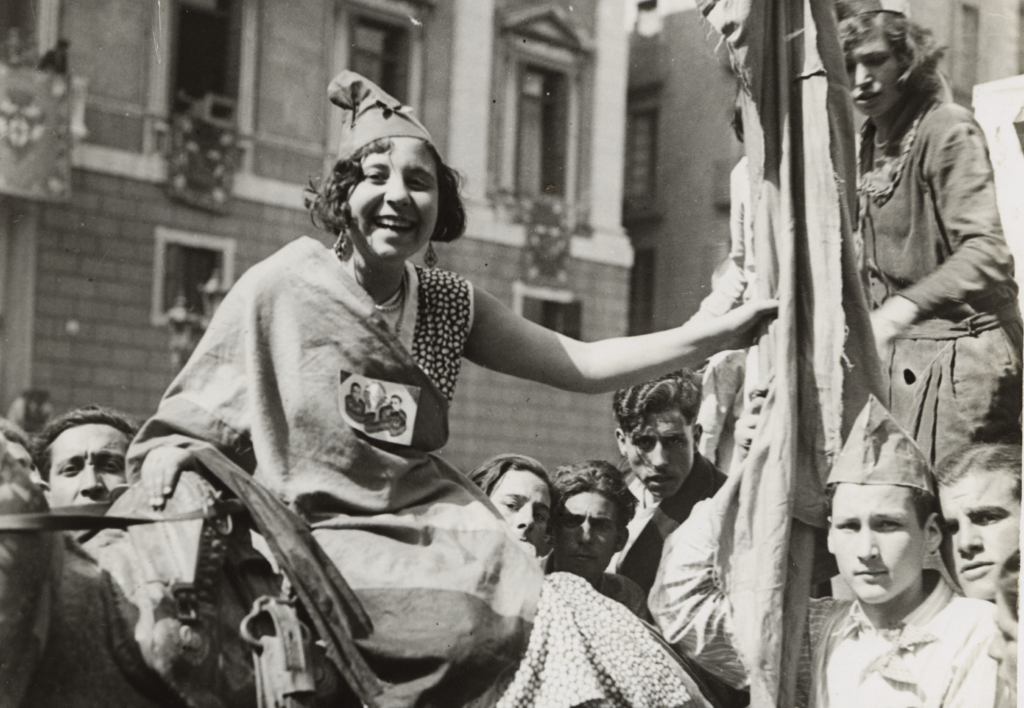
An exhibition at the Guadalajara International Book Fair revisits the struggles of Barcelona’s women: from domestic workers to those in the public sphere.
Under the title Women Will Come – 150 Years of Struggles in the Streets of Barcelona, the Museo Cabañas in Guadalajara (Mexico) is hosting, from 28 November to 1 March next year, an exhibition that explores what it means to be a woman in Barcelona through a review of the private and public struggles of the city’s inhabitants over the last 150 years.
The title plays on the phrase Flowers Will Come (Vindran les flors), the motto accompanying the many activities that Barcelona is organising these days as guest city of the Guadalajara International Book Fair, one of the most important gatherings of authors and the publishing industry in Latin America.
Among the many proposals, this exhibition is curated by Mita Casacuberta, Ingrid Guardiola and Anna Maria Iglesia. Through the works of numerous artists, writers and filmmakers, and with objects, photographs and documents contributed by many women activists, they explain how the city’s growth and modernisation from the 19th century onwards unleashed the first demands.
It was then that women began to fight for the right to make decisions about their own bodies, the right to decent work and housing, and also for political rights, for urban planning issues, for neighbourhood health and for economic independence. What does it mean to live a dignified life, and how can it be achieved? These were the questions women were asking themselves at the end of that century.
The exhibition focuses on four historical moments: the 19th century and the construction of the modern city; the Republic, the Civil War and exile; the post-war period and the Transition; and finally, the 21st century. These periods guide a display that is not chronological but instead proposes a journey through time that is both poetic and political (in the image: Popular demonstration on the occasion of the proclamation of the Republic. Militiamen in Plaça Sant Jaume, by Pau Torrents Roig and Josep Maria Lluís i Sagarra Plana; authorship as stamped on the back of the photograph. 15 April 1931. Arxiu Fotogràfic de Barcelona).
The exhibition highlights 19th-century women such as Dolors Monserdà, Carme Karr or Francesca Bonnemaison, as well as Clotilde Cerdà or Clementina Arderiu, and the female faces of anarcho-syndicalism, including Ángeles López de Ayala, Amalia Domingo and Teresa Claramunt, among many others. In the 20th century, it focuses on Mercè Rodoreda—whose verses inspired the motto Flowers Will Come—and also Anna Murià, Teresa Pàmies, Aurora Bertrana, Irene Polo or Maria Aurèlia Capmany. And it includes Colita, Montserrat Roig, Pilar Aymerich, Joana Biarnés or Rosa Regàs, among other women photographers, artists, writers and musicians.
In the 21st century, Barcelona’s reality and ongoing struggles are articulated by writers and playwrights such as Najat El Hachmi, Victoria Szpunberg or Llucia Ramis; thinkers like Marina Garcés; and poets such as Mireia Calafell and María Sevilla.
The exhibition features direct contributions from artists such as Laía Argüelles Folch, Isabel Banal Xifré, Mireia Sallarès, Ester Xargay, Marga Ximenez and Blanca Viñas, as well as filmmakers Maria Bareche Baqués and Clara Barfull, along with a wide group of writers, thinkers and playwrights ranging from Eva Baltasar and Maria Barbal to the critic and essayist Nora Catelli, and including Mercè Ibarz and Blanca Llum Vidal.
All of this is enriched with magazines, film excerpts, images and many objects and reproductions donated by feminist activists such as Gretel Ammann, connected with authors like Aurora Bertrana, Francesca Bonnemaison, Maria Aurèlia Capmany, Víctor Català, Ana María Matute or Maruja Torres, as well as works by artists from nearly a hundred years ago such as Remedios Varo or contemporary creators like Mari Chordà.
If you want to know more about this exhibition on the struggles of Barcelona’s women at the Guadalajara International Book Fair, you can consult the following link.
.