
Municipal operation for the Grand Départ of the Tour de France
Barcelona is hosting the start of the world’s most important cycling competition on 2,4 and 5 July. The event means important disruptions to circulation, public transport and various urban services in much of the city. The City Council has prepared an extensive operation prioritising mobility and public information, also guaranteeing services.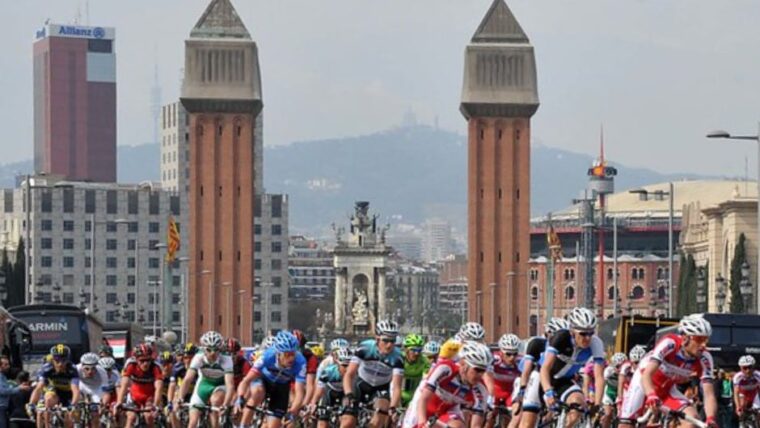
The operation, involving the City Police, Civil Protection, mobility, cleaning and urban services, will facilitate the rollout of specific measures, such as pedestrian crossings and the traffic regulation, as the circuits used in the event will be completely closed to traffic. Full details can be found on the specific mobility website for the Tour.
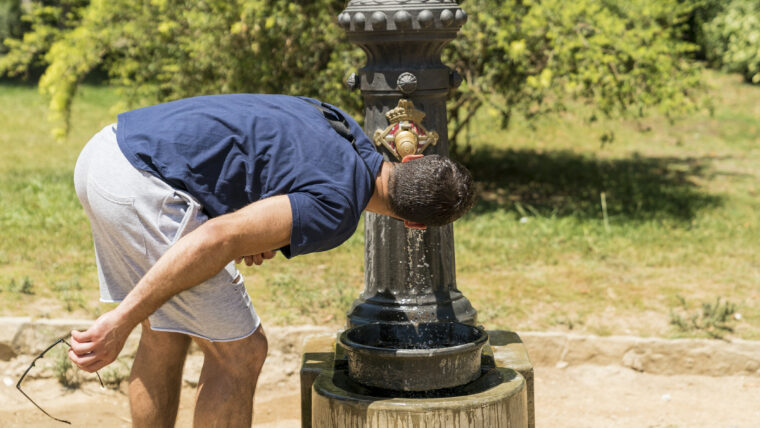
As for the high temperatures, people are advised to drink water often, carry a bottle of water with them, wear light clothing and protect themselves with a cap, hat or sunshade. Thirty-five mobile drinking fountains will be installed at points around the route so that spectators can stay hydrated, in addition to the city’s existing drinking fountains. Another recommendation is to take breaks in shaded areas or air-conditioned spaces such as those in the network of climate shelters whenever necessary.
Surface transport
During the days of the event there will be access restrictions for private vehicles in the areas near the route, as well as parking restrictions in many streets in the days beforehand. People are advised to use the metro to get around the city, which will be running between 30 and 40% more services.
Nearly 900 City Police officers will be taking part in the mobility and safety operation with special attention being paid to the regulation of traffic and protection of the busiest areas.
Team presentation
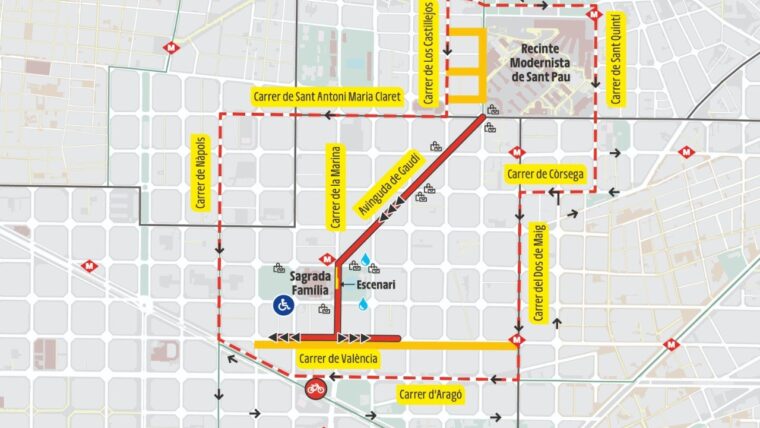
For the team presentation on 2 July, disruptions will mainly be in the area around the Sagrada Família and Av. Gaudí, which will be closed to traffic along with adjacent streets.
In this area, access will be limited to car parks and public space, with mobility mainly on foot inside the perimeter and restrictions in place during the main parts of the event
Traffic disruptions will start at night on 1 July in Av. Gaudí, with protective barriers to be set up and definitive road closures in place as from 2 pm. The main act will take place from 6.30 pm and 8 pm, with streets progressively opened up from 9.30 pm
Initial stage: time trial
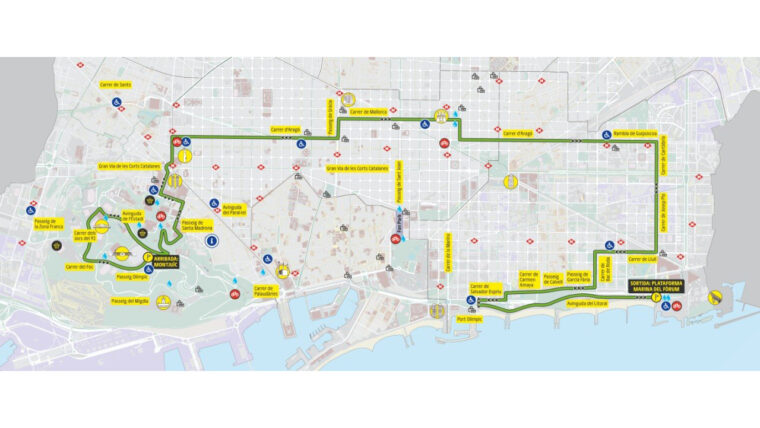
The team time trial is being held on 4 July, crossing the city from the Parc del Fòrum to Montjuïc, affecting some of the main streets: Av. Litoral, streets such as Bac de Roda, Llull and Josep Pla in Sant Martí, and structural roads in L’Eixample such as Rambla de Guipúscoa, Passeig de Gràcia and the streets of Aragó, Mallorca and Lepant. The route continues towards Tarragona, Pl. Espanya and Reina Maria Cristina before concluding on Montjuïc.
From Friday 3 July at 6 pm it will be prohibited to park anywhere around the route for the time trial. The following day disruptions start around 12 noon, with the circuit completely closed off at 1.30 pm. The most restrictive time will be between 4 pm and 7.30 pm, coinciding with the event itself, with normality to gradually be restored from 8.30 pm.
As for Ronda Litoral, occasional closures and limitations will apply at various entrances and exits, mainly in the direction of the Besòs, to ensure safety around the route and avoid interference with the sports event.
Second stage
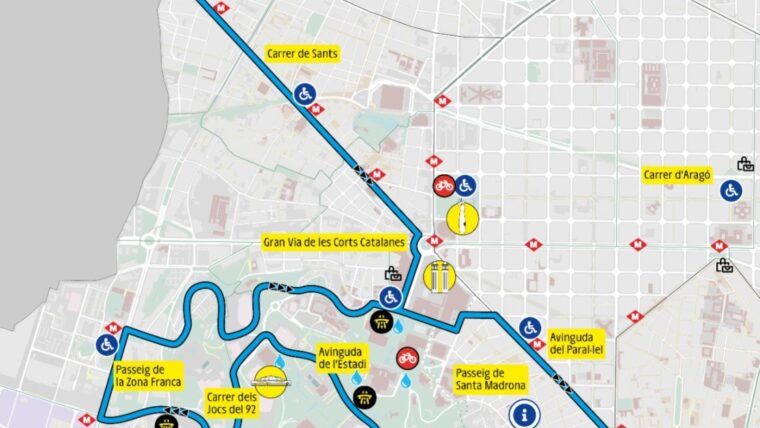
On 5 July, with the arrival of the second stage, riders will reach the city via Ctra. Collblanc and continue along Trav. Les Corts, Sants and Creu Coberta to reach Pl. Espanya. From here, Montjuïc becomes the focus of activity with disruptions in streets such as Av. Paral·lel, Passeig Montjuïc, Av. Miramar and Ctra. Montjuïc.
Restrictions will also start at 12 noon, with the circuit completely closed off at 1.30 pm. Between 3.45 pm and 5.45 pm, the mountain of Montjuïc will be practically sealed off, with circulation to be restored from 6 pm.
Pedestrain crossings
To guarantee people’s mobility, a network of over 50 pedestrian crossings will be set up above the surface around the route. These will be distributed so that there is always a point for people to cross within a five-minute walk, even though at some moments in the competition they may be temporarily regulated or closed.
These elements are designed to guarantee safety for riders and citizens alike in an event that will occupy such an important part of public space and has such a significant impact on urban mobility.
The operation also strengthens accessibility with routes adapted for people with reduced mobility or with pushchairs, with specific support to facilitate safe crossings. The whole exercise is being rolled out with coordinated planning between the City Police and Civil Protection, determining the locations and managing traffic and pedestrian flows.
Public transport and Bicing
The metro will be the main means of getting around during the Grand Départ of the Tour de France. TMB will be laying on up to 40% more trains compared to normal during these days, particularly on the L1 and L5.
On 2 July, L2 trains will not be stopping at the Sagrada Família station from midday. In contrast, the Sagrada Família L5 station will be fully operational with up to nine additional trains operating during the afternoon. As for buses, numerous lines will be disrupted and adapt their routes to the stages and the team presentation.
Some Bicing stations will be directly affected by the event. To facilitate bicycle mobility, six free monitored parking spaces will be available for bicycles and PMVs. These will be in enclosed areas with fencing, with a capacity for 150 vehicles:
- Passeig de Lluís Companys
- Parc del Fòrum
- Plaça de Pablo Neruda (2 and 4 July)
- Parc de Joan Miró (4 and 5 July)
- MNAC (4 and 5 July)
- Hotel Miramar (4 and 5 July)
Urban services
The operation entails adjustments in urban logistics, such as changes in loading and unloading times, occasion relocation of waste containers and limits on access to car park in areas affected by the route of the event.
The cleaning service will temporarily be boosted with 250 staff distributed in 120 services. The arrival of the Tour also entails the use of another 2,300 barriers and 3,500 special signs.


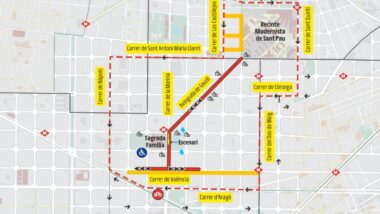 Presentation of teams in the Tour de France 2026
 Stage 1 of the Grand Départ of the Tour de France 2026
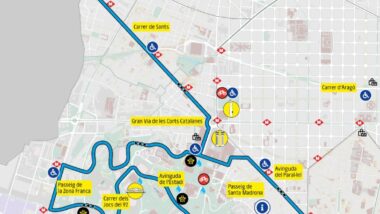 Stage 2 of the Grand Départ of the Tour de France 2026
Tags associated with the news item
Related news
-
 Sports
-
 Sports
-
 Esports
