
Barcelona: Southern Europe's leader in biomedicine
- The city's ecosystem is consolidated, with the hosting of fairs such as the 12th edition of Biospain (October 7-9).
- The sector is now focused on finding new investors in the areas of health, sustainable food and the green industrial transition.

Catalonia comprises a quarter of the total number of companies dedicated to biotechnology in the state. The Bioregion of Catalonia (as shown in the Biocat 2024 Report) currently includes 1.523 companies (dedicated to medical technology, pharmacy or digital health), and 93 research institutions such as science parks, hospitals, universities and also research centres. Of this large conglomerate, the majority (94%) is located within the Barcelona area, and more specifically it is distributed throughout the capital itself (53.4%) and the municipalities of Sant Cugat del Vallès (5,3%), Cerdanyola del Vallès (3,7%), l’Hospitalet de Llobregat (2,6%) and Terrassa (2,1%).
The territory, with Barcelona at the forefront as a reference epicenter in science and innovation, is fifth in Europe and eighth worldwide in clinical trials, and the continental leader in importance in citations of articles and publications within this field. A context that generates in economic terms 7,6% of the total Catalan GDP and as a sector it occupies third place, only behind commerce and the entire real estate field.
Catalonia, and especially Barcelona, lead the state's biotechnology sector with 1.523 companies (dedicated to medical technology, pharmacy or digital health), and 93 research institutions.
Cutting-edge initiatives
These overall figures are complemented by specific examples that have recently taken root in the city of Barcelona. The first of these is the agreement to establish the new Fraunhofer Cat center in the city, a complex specializing in advanced engineering and therapies, which will operate under the umbrella of the Fraunhofer Spain Foundation. The center will be directed by Professor Josep Samitier, director of IBEC (Institute for Bioengineering of Catalonia), and its primary objective will be to develop innovative technologies that aid in diagnosis, prognosis, and therapy selection. €25.5 million will be allocated to the project until 2031, of which €8 million will be contributed by the Barcelona City Council.
Furthermore, the city has also inaugurated the AstraZeneca Global Hub, a complex that is located at the emblematic Estel building, on Rome Avenue. It will consist of a thriving research center in advanced therapies and precision medicine, which will combine scientific knowledge with technology and artificial intelligence to accelerate our treatments for patients. They will invest 1.300 million euros by the end of 2027 to enable new talent, internationalize the Catalan biomedical sector and position Barcelona as a European benchmark in the field of medical bioengineering.
State ecosystem
Comparing, the relevance of the Barcelona and Catalonia environment in general in the peninsular context is very clearly seen. In the state as a whole, the biotechnology sector represented 2,49% of the overall production in 2023 (according to data from the AseBio 2024 report) and now has 1.000 companies dedicated purely to biotechnology, in addition to another 4.400 that work in this area on a secondary basis. Of all of them, 47% work in the health field, while 42% do so in the food sector.
One of the events that most strongly promotes the state biotechnology sector is Biospain, the largest congress of the guild, which this year returned to Barcelona and was held again between 7 and 9 October at the Fira de Barcelona in Montjuïc. The Fair has thus reached its 12th edition and has repeated itself in the Catalan capital, which had already successfully hosted the 2023 edition and Bio Europe, the continent's key congress within the sector which was held in March 2024.
Biospain, the Biotechnology Fair, has exceeded data this 2025 and has had the participation of 2.400 people, 1.065 entities, 250 exhibitors and 140 investors.
This year's new edition has confirmed rising figures that describe the exponential progression of an entire field that is becoming more relevant. If in 2023 Biospain broke records (and had 2.200 professionals), this October it has surpassed data because 2.400 people (from 34 countries) 1.065 entities, 250 exhibitors and 140 investors have participated. All this crowd has led to the holding of 4.500 meetings, which serve to establish new synergies between companies, potential workers, professionals and sources of financing.
Biospain: objectives and news
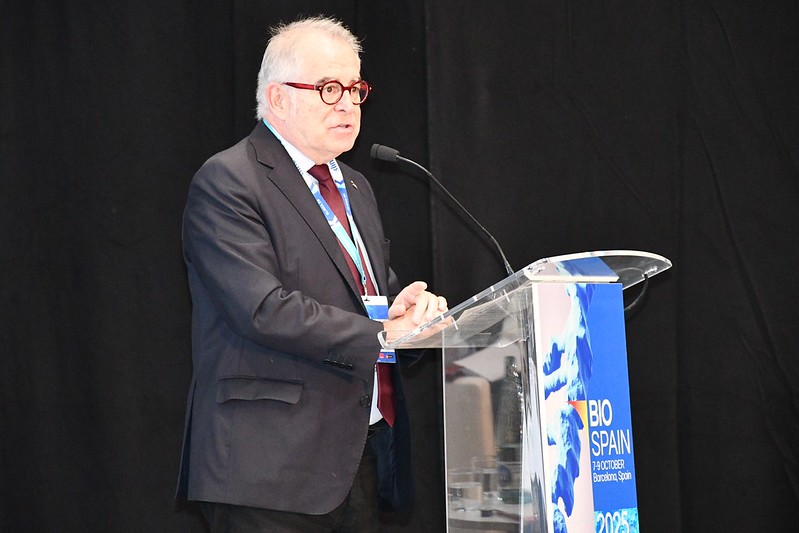
Biospain, jointly organized by AseBio (Spanish Association of Biocompanies) and Biocat (the Bioregion of Catalonia), began to be held in 2001 and until this year was biennial. It is a strategic space whose main objective is to strengthen public-private cooperation, to promote frontier research and the internationalization of companies working in the biotechnology sector (in the fields of health, the environment, agriculture or innovation in industry).
A priority goal is to be able to achieve that both Spain and Europe are self-sufficient in a sector that is preeminent, not only to boost the economy, but also and above all to strengthen people's well-being and create a sustainable development framework. The Secretary of State for Science, Innovation and Universities, Juan Cruz Cigudosa, in this regard, highlighted the commitment of the Spanish government to strengthen the biotechnology ecosystem, promoting an ambitious agenda of support for research, innovation and knowledge transfer, through programs and instruments designed to accompany the progression of this sector and consolidate its role as the driver of a more competitive and sustainable production model.
A primary objective is to achieve that both Spain and Europe are self-sufficient in a sector that is a priority for boosting the economy, strengthening people's well-being and creating a sustainable development framework.
Advanced therapies
The methods that are emerging to evaluate drugs and treat many diseases occupy a large part of the biotechnology market, which is on the rise, and in turn allows for relevant advances for health. This 2025 Biospain has organized different conferences, debates and presentations that have highlighted discoveries in gene therapies, dark DNA, oncological immunotherapies and also the rise of models to combat microbial resistance or neurodegeneration.
To promote all this, evaluation systems (which are used to test drugs or carry out applied or basic research) are essential to progress in the speed of diagnosis, have new remedies, and also to leave aside or reduce animal experiments, which apart from the damage and suffering caused, are not very precise and comparable.
Within this context, the concept of Health Technology Assessment (HTA) takes on relevance, and designates the process that advises and scores a healthcare evaluation system in different phases to promote its efficiency and development. The regulatory process, which largely depends on the European Union, was discussed at the Salon as a key point, as well as the immense importance that artificial intelligence or other biotechnologies such as 3D bioprinting also play in these devices that allow experiments and different research.
The general director of AseBio, Ion Arocena, highlights on this point that “artificial intelligence is generating a major revolution in biomedical research, with the discovery of drugs, the streamlining of processes and clinical development”. He defends in this line “the essential convergence of biotechnology with the entire digital world and also the need to retain multidisciplinary talent and establish collaborative frameworks that accelerate innovation and make companies grow”. Biospain serves and acts within this framework to attract new investments, weave a network and strengthen relationships between different professionals and also attract emerging research. A consolidated space within the Fair, the Talent Day, which is dedicated precisely to connecting researchers who are looking for work or who are starting with various companies, was held on the last day and brought together more than 400 people.
Ion Arocena: "artificial intelligence is generating a major revolution in biomedical research, with the discovery of drugs, the streamlining of processes and clinical development".
In Catalonia, in this area, Biocat has launched a new Advanced Therapies Hub, where all companies dedicated to the development of medicines for human use based on gene, cell, tissue engineering therapies and combinations with other products can participate. The intention is to promote collaborations, strengthen knowledge and boost research, manufacturing and development in the field of personalized medicine, and also make it accessible to all citizens.
Food and respect for the environment
Beyond health, two booming fields within biotechnology are the agri-food branch and innovation in new, more sustainable materials for industry. Biospain 2025 presented in this area, startups and companies that work on regenerative agriculture projects, more resistant varieties of new crops, or capture and use of CO2. And it invited Switzerland, as a leading country in the “biotech” field on an international scale.
In this field, the industry dedicated to creating new foods, “alternative proteins” in laboratories, such as “cultured meat”, also takes on great relevance. It is an area that has received a strong boost in recent years and where many investors have invested, especially in the United States, where in 2023 the sale of cultured chicken meat produced by Good Meat and Upside Foods, two Californian startups, was approved for the first time.
Arocena, as the highest representative of AseBio (and, therefore, of the state's biotechnology sector) believes that now "the challenge is for Europe to establish new standards, and become an agile and favorable environment, for the alternative food industry, to grow established companies and those that may emerge".
As a central event within this guild in Catalonia and the state, Biospain, which due to demands from the sector now becomes an annual event, will be organized again in Barcelona in 2027 and negotiations are also underway to confirm the 2029 edition.