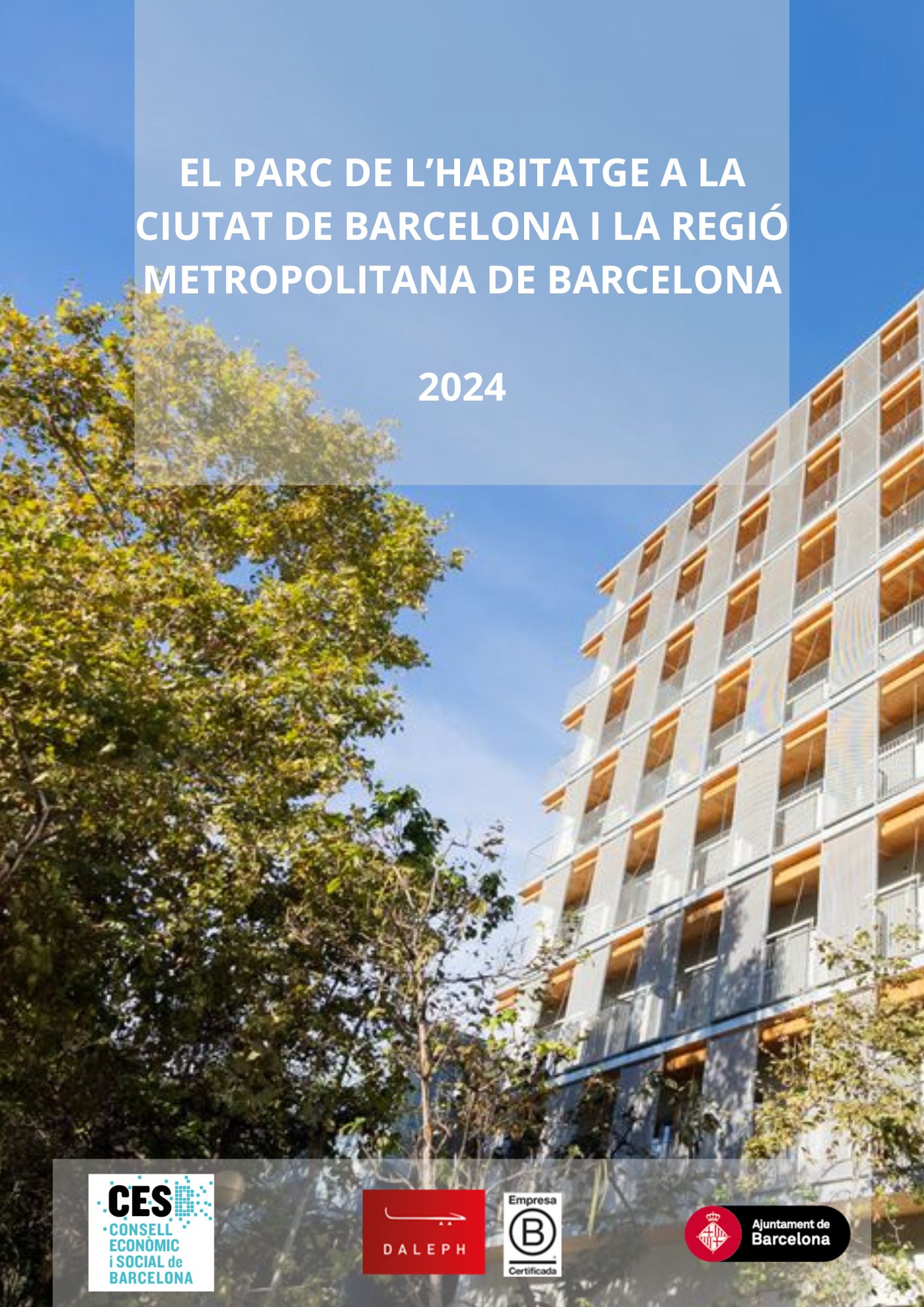
Housing stock in the city of Barcelona and Barcelona Metropolitan Region 2024
This report has presented the current state of housing in the Barcelona Metropolitan Area, an issue that has gained prominence in recent times due to the housing emergency affecting a significant part of the population, especially around large cities such as Barcelona.
The various chapters have introduced elements that, when combined, define an image of the problems facing housing in Barcelona. The Barcelona Metropolitan Area has more than 2,200,000 homes, offering diverse environments with very different types of housing, so that it can respond to the needs and preferences of very different people.
The Barcelona urban continuum (areas of Baix Llobregat Sud, Barcelona, and Barcelonès) is characterized by small flats where few people live, while as we move away from the city, homes are larger and households have more members. However, price does not seem to be closely related to proximity to Barcelona. Although Barcelona and Baix Llobregat Sud have very high prices, the rest of the areas do not seem to follow any pattern. Prices may be influenced by factors other than proximity to Barcelona, such as the characteristics of the homes in each area, connectivity with the capital, proximity to other job hubs, or even the coast. Despite the difficulty in identifying patterns in prices, it seems clear that there is a widespread desire to live near Barcelona and that, in order to do so, it is necessary to make sacrifices in terms of housing quality, such as having less space or living in older buildings.
However, in general, prices have maintained an upward trend in recent years, with Barcelona being the most affected. The supply of rental properties has recently decreased, while prices have increased across all areas. In the sales market, meanwhile, the increase has been more moderate, while supply has fluctuated. There is clearly an imbalance between supply and demand. The latter requires housing at a price well below the market rate, driving those who cannot afford the rising costs to more affordable areas. This imbalance particularly affects the city of Barcelona, where there is huge demand and supply well above the demand price.
The pause in housing construction following the 2008 crisis is another factor contributing to this imbalance. Although the Barcelona Metropolitan Area has experienced higher growth in housing than in population over the last 30 years, a trend that is particularly marked in the areas closest to Barcelona, this has not been enough to balance supply and demand. Other factors observed in this report therefore come into play in this imbalance. Among them, the change in household composition, with the dual trend of an increase in single-member households and a growth in households of six or more people, means that, despite the growth in the number of homes, this is not enough to meet the entire demand.
Furthermore, the number of existing homes cannot be equated with supply. Vacant homes could account for a significant percentage of the housing stock, while homes used for tourism also reduce the total supply of housing. It is therefore not just a question of building new homes, but of ensuring that new homes enter the market for residential use. In addition, it is necessary to understand the socio-demographic changes that are taking place in society. Specifically, it is necessary to study changes in household composition in greater depth in order to guide effective policies to address the challenges that arise.
Housing access problems are exacerbated by the lack of protected housing, which accounts for less than 3% of the metropolitan housing stock. The proliferation of tourist accommodation, concentrated in the city of Barcelona and coastal areas, is another factor that further exacerbates the situation, as nearly 1% of the metropolitan housing stock is used for this purpose.
Given that access to housing particularly affects people with certain profiles, such as young people or those born in countries in the global south, these population groups are doubly affected by housing access problems. Furthermore, for some of these groups, such as foreigners of certain nationalities, this could be an additional effect of the discrimination they suffer. These profiles are pushed towards poorer quality housing, with less space for the people living in it, or further away from the most sought-after areas.
Although certain social groups are more affected, housing access issues directly impact half of the metropolitan population, as it is estimated that around 50% of residents in the Barcelona Metropolitan Area will have moved (or would like to have moved) during the period 2018-2027. All of these people will experience or have experienced first-hand the increase in prices. Young people, as the group that changes homes most frequently, will be particularly affected, while only a minority of older people will be affected. These generational differences could lead to a dissonance in the perception of the problem by different age groups, further increasing the difference in the importance that different generations attach to the housing problem.
Contrary to what one might expect, the process of residential mobility is not satisfactory in all circumstances. Although the degree of satisfaction is higher among people who have moved than among those who plan to do so, the reason for the change of residence is a determining factor in the degree of satisfaction: people who move in search of better housing or surroundings are more satisfied than those who do so due to external circumstances.
Although most people move house to improve their living conditions or for family reasons, between 20% and 25% of those who have moved house in the last five years have done so for economic reasons. With the upward trend in rental and purchase prices, this percentage is expected to increase over the next five years, even if the people themselves do not anticipate it. Furthermore, the low level of mobility towards Barcelona indicates that the city is pushing people out to the suburbs in a one-way movement.
As a final reflection, these pages have shown how housing is a complex problem that affects a significant portion of the metropolitan population. As it is an issue that is affected by a multitude of inputs, there are no easy solutions to resolve it. Any solutions that are proposed will have to be as complex as the problem they seek to solve. We are undoubtedly facing one of the greatest problems of today's society, and solving it will be the great challenge of a generation.