


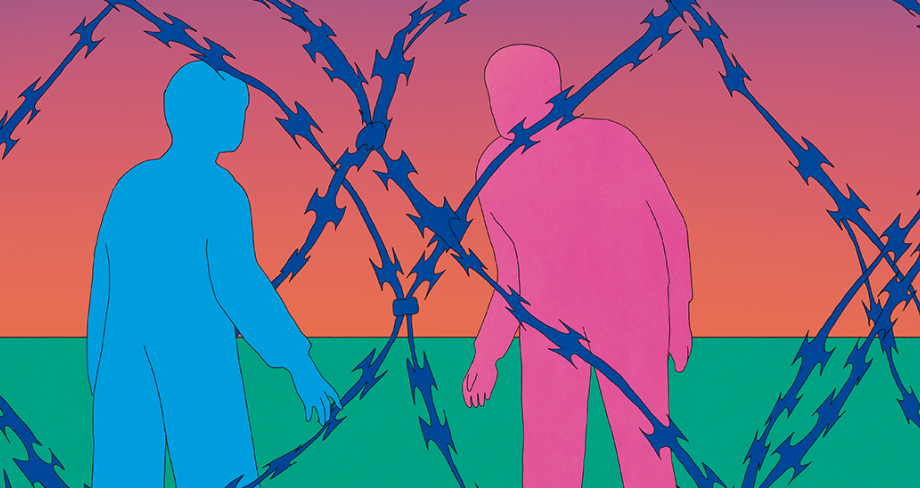
© María Medem
For various reasons, solidarity has not been one of the values most appreciated or cultivated in modern times. Secular societies have dispensed with appeals to Christian charity, replacing them with the concepts of fraternity or solidarity. Yet, as society becomes increasingly individualistic, these values are no longer afforded the same consideration as others, such as freedom and equality.
It is well known that the value of fraternity is not proclaimed in the Déclaration des droits de l’homme et du citoyen of 1789, where the three fundamental rights are liberty, equality and property – the last being hardly compatible with the idea of a universal fraternity. Moreover, alongside justice, which grants citizens the status of being free and equal, solidarity is often viewed with suspicion: as with the old idea of charity, solidarity is invoked precisely where justice is lacking. The utopian socialist Louis Blanc lamented that the French Revolution had forgotten one of its revolutions – that of fraternity, which might have countered the excesses of individualism established by liberal ideology. From that moment onwards, despite the innovations introduced by socialist movements, the greatest challenge has been to broaden the scope of the we, within which a genuinely solidarity-based character (ethos) can form.
The difficulty of building societies based on solidarity has grown as original liberalism – which represented moral progress by assigning supreme value to individual freedom within the normative hierarchy – evolved into neoliberalism, with its unrestrained market economy indifferent to the common good. The individual shaped by an economic system that prioritises production and consumption while ignoring inequality is a consumerist subject who values above all purchasing power, material success and the accumulation of wealth.
Individualistic freedom
The moral outlook cultivated by individuals in neoliberal societies is grounded in the near-absolute value of freedom – understood as the ability to do anything permitted by law. This is an individualistic conception of freedom: the possibility of satisfying any desire and choosing whatever best serves one’s own interests – the freedom to do “whatever I want, whenever I feel like it”. It is what Isaiah Berlin called “negative freedom”: a narrow, impoverished and ultimately unambitious conception for building democracies united around shared ideals.
Freedom means self-government, autonomy – not acting without rules but being guided by those rules one considers to be right.
This notion of freedom has two major flaws. The first is that it develops in isolation from the conditions needed to ensure freedom for everyone. The second is that it fails to recognise that freedom also means self-government, autonomy – not acting without rules but being guided by those rules one considers to be right. Thus, the libertarian individual – today’s prevailing type, though not truly liberal – habitually disregards whatever does not serve personal interest and ignores the fact that how one exercises freedom can affect the degree of freedom enjoyed by others. In the words of Nelson Mandela, such a person forgets that “to be free is not merely to cast off one’s chains, but to live in a way that respects and enhances the freedom of others”.
As for the second point, negative freedom does not raise questions such as: Why am I free? What should I do with my freedom? Who really influences my decisions? As Philip Pettit – who defends the theory of freedom as non-domination – explains, the freedom we enjoy ceases to be genuine when we allow ourselves to be influenced or dominated by whatever sweeps us along: by what everyone else does, by fashion, or by what is deemed politically correct – different forms of domination of which we are often unaware.
Patrick Deneen, for his part, argues that liberalism’s failure stems from the individual’s inability to practise self-restraint. As he puts it, people forget that the concept of freedom also includes “the learned capacity to govern oneself using the higher faculties of reason and spirit through the cultivation of virtue”. Virtues such as solidarity, benevolence, trust, respect and temperance do not flourish, nor can they be learned, in a world governed by the market economy – a world that teaches everyone only how to consume.
Now that the teaching of ethics is no longer seen as a religious responsibility, and moral values are believed to lie in principles such as human rights – meant to apply universally – it seems as though these supreme values could somehow spread and take root without any deliberate effort. As a result, we live in societies where, beyond what the law compels through coercion, everything is permitted. Who teaches people to respect one another, to moderate their desires, to show active solidarity with those who suffer or are condemned to live in inhuman conditions? How are virtues learned in an environment that celebrates confrontation, hostility towards outsiders and strengthens what divides us rather than what unites us?
In the notes Thomas Jefferson wrote while drafting the United States Declaration of Independence, we read that the most fundamental right defining a free person is the right to leave the place of one’s birth. The Universal Declaration of Human Rights of 1948 explicitly recognises the right “to freedom of movement and residence within the borders of each State”. How does that right stand when we compare it with the reluctance of states to make a genuine effort to welcome migrants forced to leave their homeland and to guarantee them a dignified life?
Entrusting state institutions alone with the task of building a fairer society is a mistake.
Solidarity and justice go hand in hand
As mentioned earlier, solidarity is often regarded as a somewhat suspect virtue – not only for its religious undertones, but also because the bond it promotes with others is insufficient to transform structures of inequality. Only the state, with the legitimacy granted by the coercive power of law, can and must strive to achieve justice. Yet entrusting state institutions alone with the task of building a fairer society is a mistake. Public policies cannot take shape when support from what is known as civil society is absent. Would governments remain so indifferent to migration policies if citizens were to exert real pressure – through complaints, demonstrations and every kind of public protest – urging them to be more proactive and to do everything possible, even impossible, to address what has long been a problem that no one seems willing to resolve? Why should they change course when public opinion is increasingly drifting towards xenophobia and racism?

© María Medem
We must recognise that solidarity and justice go hand in hand. A society grounded in solidarity compels governments and public administrations – and even private companies, which enjoy large profits and seek to win public trust through altruistic gestures – to act where they are currently failing, helping to redress inequalities. A solidarity-minded citizenry brings to light needs that those in power either do not see or choose to ignore. This is the role of what is known as the third sector, which often takes the lead in offering care and protection to those most in need when public authorities look the other way. Thus, we can conclude that justice needs the complement of solidarity, which should form a cornerstone of civic commitment – the duty that everyone owes to their immediate community, beyond simply paying taxes. The old belief that solidarity arises only where justice is lacking should be replaced by a new one: even where justice exists, there must also be solidarity, if only to ensure that the pursuit and demand for justice never fade.
However, such complementarity will not come about while the dominant narrative continues to sow division among citizens – between us, those who live under the protection of the rule of law, and them, who are portrayed as disturbing the peace we believe belongs to us or that we deserve. This is the rhetoric championed by the political right, quickly absorbed and applauded by a population which, amid crises and uncertainty of every kind, finds comfort in identifying scapegoats. These are the people supposedly threatening the well-being of native citizens and claiming rights they do not deserve: the right to work, to housing, to education, to healthcare and to citizenship itself. Hannah Arendt long ago reminded us that the truly excluded are those who lack even the right to have rights.
Looking the other way
Right-wing populism, founded on the idea of national belonging as an unquestionable privilege of native citizens, fosters both a lack of solidarity and the rejection of those who are different. This effect can be widespread, especially given the left’s inability to present a coherent class-based discourse. The Marxist slogan “Workers of the world, unite!” no longer mobilises anyone to look beyond the defence of what each person regards as their own rightful property. Open borders and internationalism no longer have a place within the framework of social demands. The welfare state has been tottering for some time, as political interests turn a blind eye and everyone finds in immigration a convenient excuse to avoid taking responsibility for maintaining services they believe go beyond their social obligations.
The result of all this is the ongoing erosion of social justice and solidarity. It takes little more than immigrants displaying cultural traits that seem strange or unfamiliar to native citizens for resentment, unease and the denial of recognition of the foreigner – simply for not being “like us” – to grow.
In conclusion, only the willingness to bring cultures together, to do away with artificial rights of belonging – such as belonging to a state has always been – and the critical examination of prejudice and stereotypes, will transform the violent and polarised world we live in into one where solidarity can truly flourish.
References
Camps, V. Virtudes públicas. Arpa Editores, Barcelona, 2019.
Camps, V. La sociedad de la desconfianza. Arpa Editores, Barcelona, 2025.
Deneen, P. Why Liberalism Failed. Yale University Press, New Haven, Connecticut, 2018.
Seboul, A. La Revolución Francesa. Crítica, Barcelona, 1987.
Stiglitz, J. The Road to Freedom. Norton & Company, New York, 2024.
RECOMMENDED READING
-
La sociedad de la desconfianza
Arpa Editores, 2025
-

Tiempo de cuidados
Arpa Editores, 2021
-