Ferment to transform: harnessing food at schools
Cuchara organises an awareness raising campaign about food waste aimed at families and students from educational centres, with support from the “Impulsem el que fas” subsidy programme.
The aim is to place the kitchen at the centre of our lives and raise awareness about the decisions we make when we choose what to eat and how to consume.
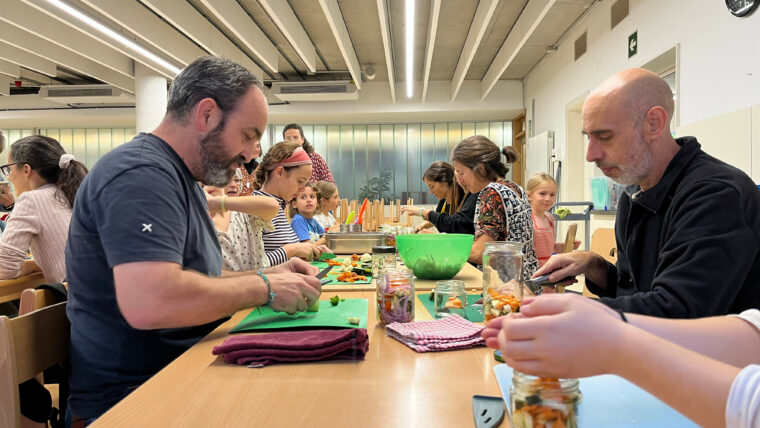
Last Tuesday, Cuchara organised a workshop at Escola Anglesola in Les Corts, at which families and students learned how to ferment leftover vegetables and fruits from the school cafeteria step by step. The workshop forms part of the organisation’s awareness-raising project as well as the school’s plan to combat food waste, which they hope to soon be able to apply to the cafeteria service.
How do we ferment?
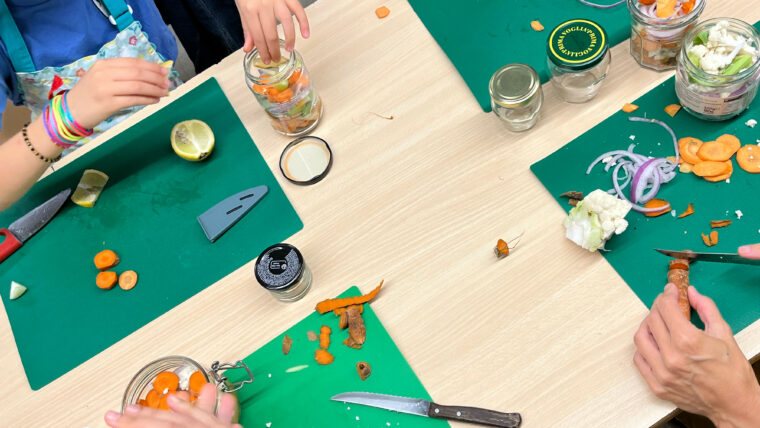
To ferment vegetables, simply cut them freely into the shapes of your choice, place them in glass jars filled to the top and cover them with salt water (30 grams of salt per litre) until they are fully covered. Using the salt, our aim is “controlled putrefaction”, in other words, we ferment it and fill it to the to to prevent any oxygen from remaining. Placing a slice of lemon on top will help prevent it from blooming. Once the jar is closed, simply keep it at room temperature in a place protected against direct sunlight for about 7-10 days, until it is ready, and then store in the fridge.
Fermentation: a transgressive practice
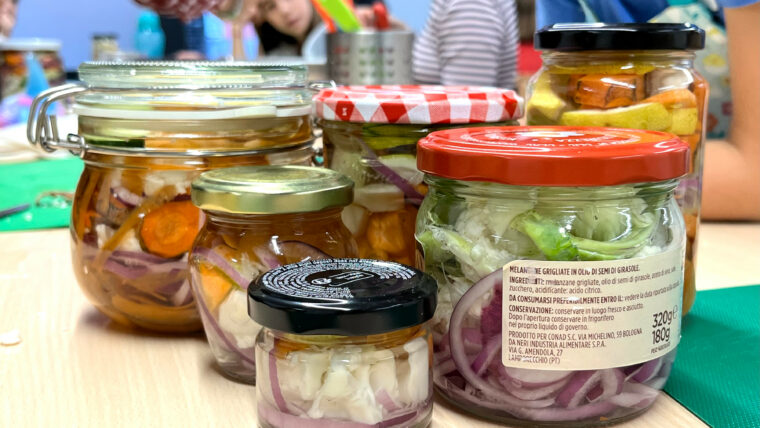
Fermentation is all about reuse. As part of the workshop at Escola Anglesola, families were able to create their own jars of fermented candied vegetables from surplus food from the school cafeteria. Cuchara teaches participants how to make use of any vegetables left at the bottom of your fridge or the parts that we typically remove, such as the peel.
Apart from preventing waste, fermentation also has health benefits. The process favours the generation of certain bacteria, such as probiotics, which are good for our intestinal flora. Nowadays, you’d be forgiven for thinking that food can only be preserved in fridges; however, fermentation is an age-old, widespread preservation practice used around the world. For example, yoghurt, cheese, wine or bread are all made using the fermentation process in some way.
“Impulsem el que fas” subsidies
The awareness-raising workshops on food waste organised by Cuchara have been financed as part of the “Impulsem el que fas” annual subsidy programme run by Barcelona City Council, through Barcelona Activa. This programme seeks to contribute to the growth of the local economy by promoting local projects that respond to the needs and challenges of local residents, including sustainable food and responsible consumption initiatives.
More information