More Romanesque art at MNAC
Since May, the Catalan National Art Museum has worked to incorporate fragments of mural paintings preserved until now in the reserve into the collections of Sant Climent de Taüll, Sant Pere de Burgal and Sant Joan de Boí.
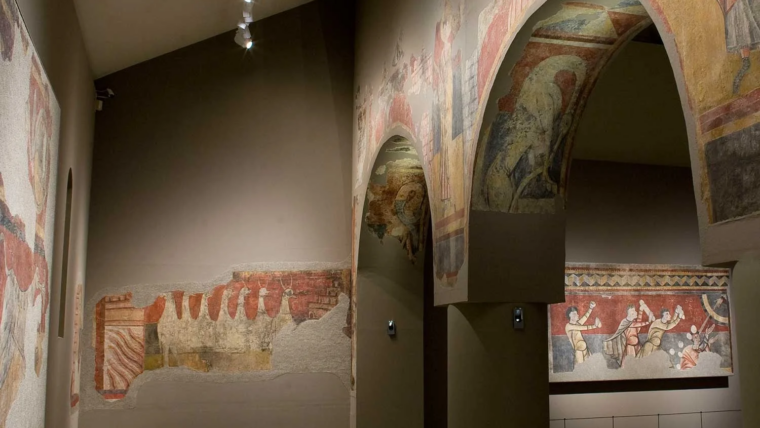
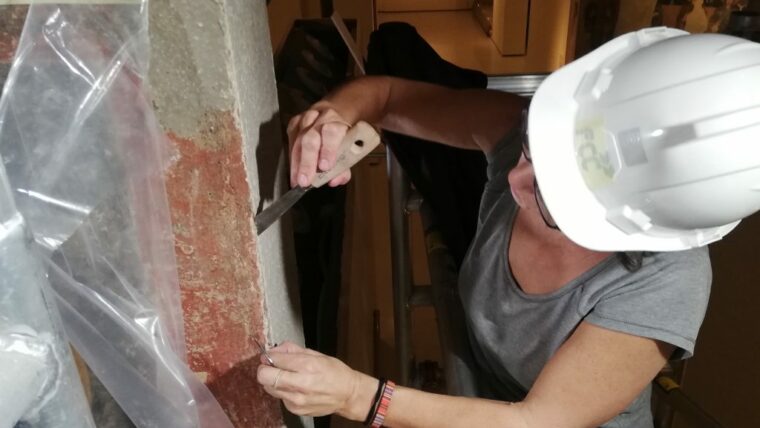
The technical teams have worked in an interdisciplinary fashion to recover these fragments and have been able to identify, study and restore them. Once their original location is determined, they will be progressively incorporated into the rooms in a process that will culminate in September.
As for Sant Climent de Taüll and Sant Pere de Burgal, these additions are very important because they are fragments of considerable size in which the iconographic representation is very well preserved, as is the case with the figure of Cain. In the case of Sant Joan de Boí, fragments of the decoration of the paintings that were located in the columns of the church will be added.
Before adding these paintings in the rooms open to the public, a long and complex series of processes have been carried out, including study of the fragments, their history and location, consolidation and cleaning of the materials, preparation of traces of the images to check their fit and chemical analyses of the materials to provide information on the nature of the pigments, as well as unpublished data on the execution process.
This series of works began 900 years after the consecration of the churches of Sant Climent and Santa Maria de Taüll and as part of the centenary of the rediscovery, removal and museumization of wall paintings, as well as the formation of the main nucleus of the current collection of Romanesque art of the MNAC. Due to their complexity and special characteristics, these tasks will be extended over a three-year period, from 2023 to 2025.
History of removals
The most important part of the museum’s mural painting collection was gathered in a project carried out between 1919 and 1923. It was discovered that the Romanesque paintings of the church of Santa Maria de Mur had been torn from the walls and sold to private individuals. The rest of the Catalan Romanesque mural painting was considered to be in danger. Between the autumn of 1919 and the year 1923, the paintings were acquired, removed from their original support —the walls of the churches— and moved to Barcelona, where they were fixed on another support and prepared for exhibition in the museum.
Almost all the Romanesque wall paintings in the museum were removed using the strappo technique, that is, only the pictorial layer was removed, leaving the plaster on the original wall.