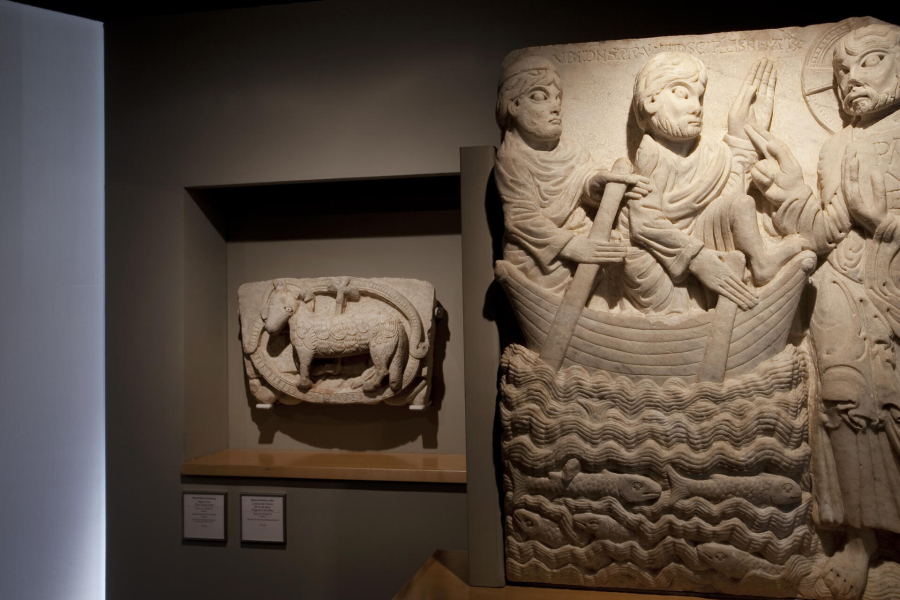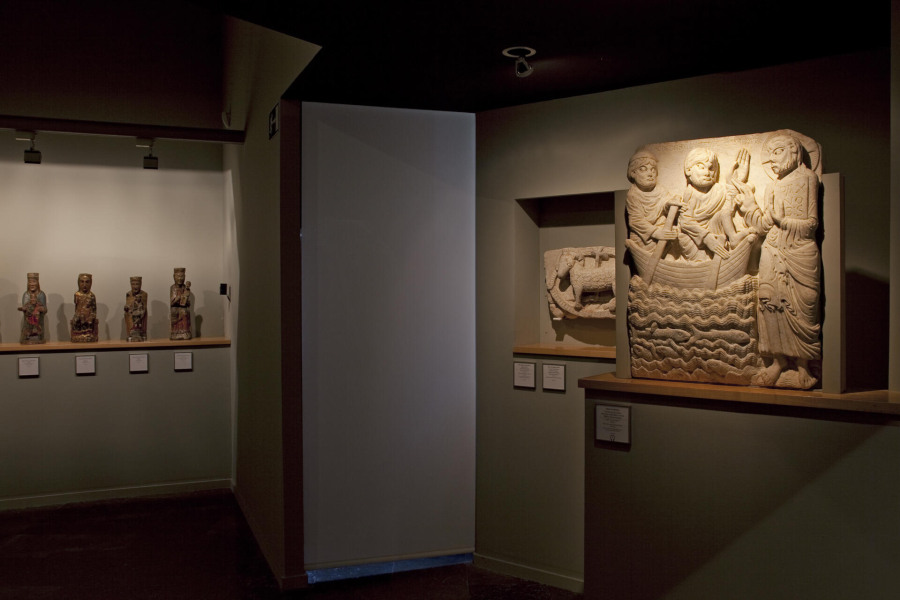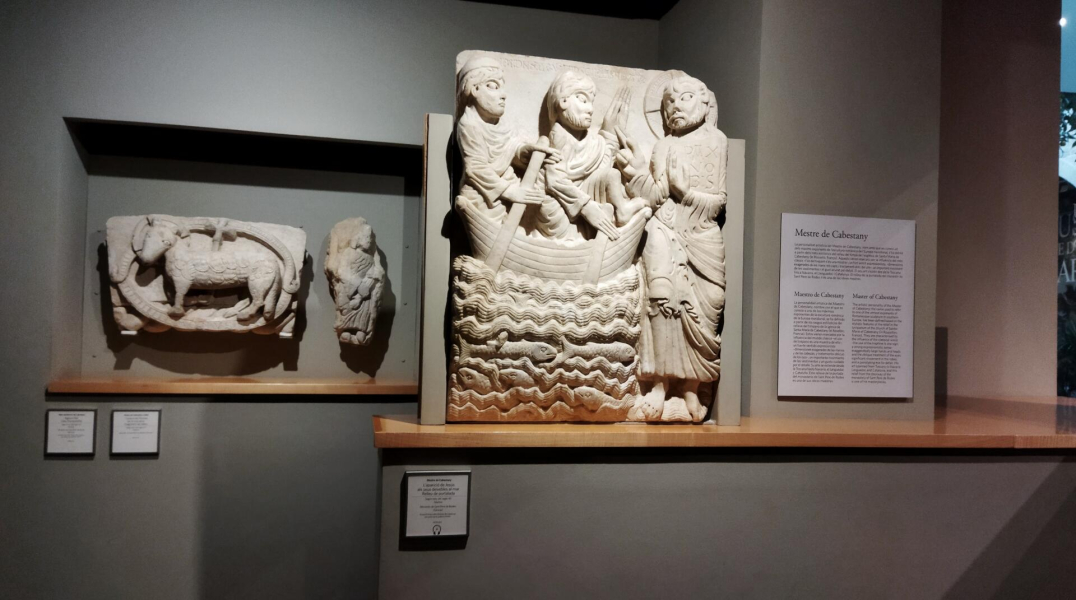

The appearance of Jesus to his disciples at sea. Portal relief
The appearance of Jesus to his disciples at sea. Portal relief

From room 2 we begin the tour of the museum's Romanesque sculpture, represented, on the one hand, by the sculpture linked to monumental architecture, which has the best example in the relief of the Master of Cabestany, and, on the other, by the furniture sculpture that beautified the interior of the churches, mainly carvings of the Virgin and Child, Christ crucified and Calvaries, which were located in prominent places, such as the altar.
We are facing the most important work in the museum, made by an anonymous artist known as the Master of Cabestany. He was a sculptor of great quality, active during the second half of the twelfth century, who worked in Tuscany, Languedoc, Catalonia and Navarre. This relief was part of the western portal of the Benedictine monastery of Sant Pere de Rodes, in Girona, and is considered one of the most remarkable works of the artist and his workshop. It was made in the second third of the twelfth century. It is a reused block of marble, as indicated by the sculptural remains that can be seen in the back.
The scene represents the appearance of Jesus to his disciples at sea, as confirmed by the inscription located at the top of the relief. Jesus is standing on the water and blesses the apostles. St. Peter rests his left foot in the attitude of getting out of the boat and St. Andrew holds the oar. The lower part of the relief is occupied by the representation of the sea with waves and moving fish, solved with great plastic sense.
The artistic personality of this master is marked by the influence of the classical world, and this is demonstrated by the recovery of the trepan technique and the strong expressionist sense, which is evident in the disproportionate dimensions of the hands, the angular treatment of the faces and the almond-shaped eyes.
At the end of the 18th century the monastery was abandoned, the church portal was partially destroyed and some of the remains passed into the hands of collectors. This relief, the only episode of the entire ensemble that is preserved intact and in perfect condition, was acquired by the "Friends of the Museums of Catalonia" by popular subscription and was donated to the Frederic Marès Museum in 1960. The Museum exhibits two more sculptural fragments that come from the same portal, a keystone with the Agnus Dei and a fragment with a figurative relief.