


Lying Nude (Plenitude, Spring)
Lying Nude (Plenitude, Spring)
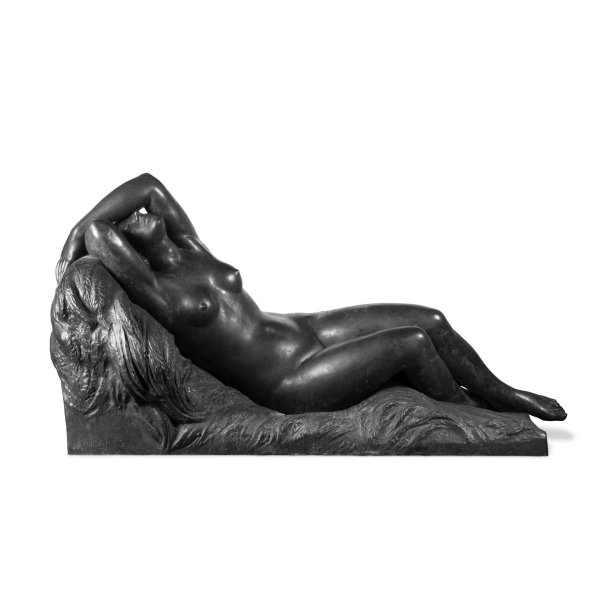
The presence of women is a constant in the production of Frederic Marès, from religious works to figures and busts of noucentist idealization, but it is in this reclining nude that the sculptor approaches the most sensual representations of the female figure.
We must look for the precedents of this sculpture in works of naked and standing women such as those that appear in Rhythm, Fullness (1920), or Nu -represented at the National Exhibition of Fine Arts in 1926-, and in some reliefs from the thirties.
The naked woman presented by Marès is lying in a field of wheat, but Marès refuses to treat nature as a mere support and enhances the idea of globality between the elements, not only with the treatment of wheat as the bed of the figure, but also with the entwining of the hands with the ears. The representation of ripe wheat, the twisting of the body and the position of the arms half-hiding the face emphasize the voluptuousness of the figure, a feeling that is highlighted with the subtitles of Fullness or Spring with which the work is known.
Marès presented this bronze sculpture at the National Exhibition of Fine Arts in Madrid in 1936 and, after the Civil War, in 1941, and on this occasion it was awarded a second medal. He later participated in other contests, which shows that the aesthetic taste of official circles had undergone little change.
In 1982, Marès gave this sculpture to the Barcelona City Council to install it in the lobby of the Casa de la Ciutat, and made a new cast of it, which is the specimen kept in the Museum.
