
Saint Anthony of Padua
Saint Anthony of Padua

One of the most exceptional artists of the Spanish Baroque is Gregorio Fernández. He lived and worked almost permanently in Valladolid, where he directed a fairly active workshop in which a large number of collaborators worked. Died in 1636, his influence remained on Spanish sculpture throughout the 17th century, and his models were repeated by his disciples and collaborators.
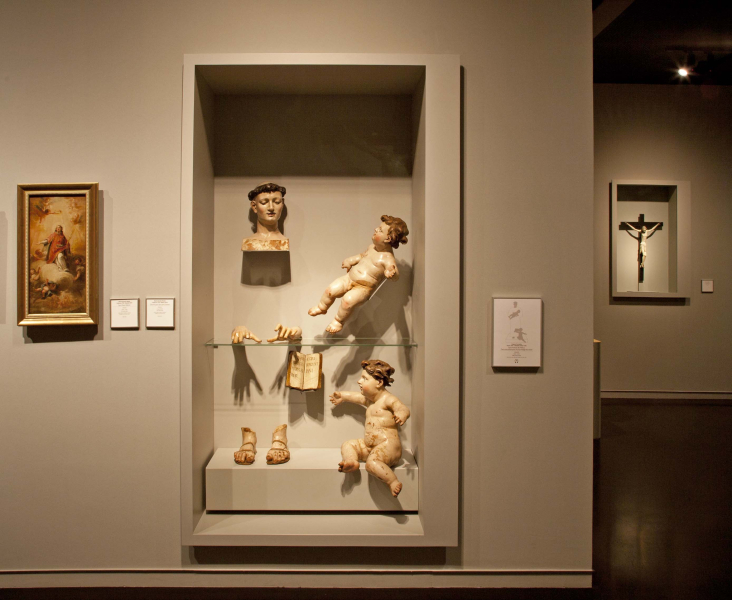
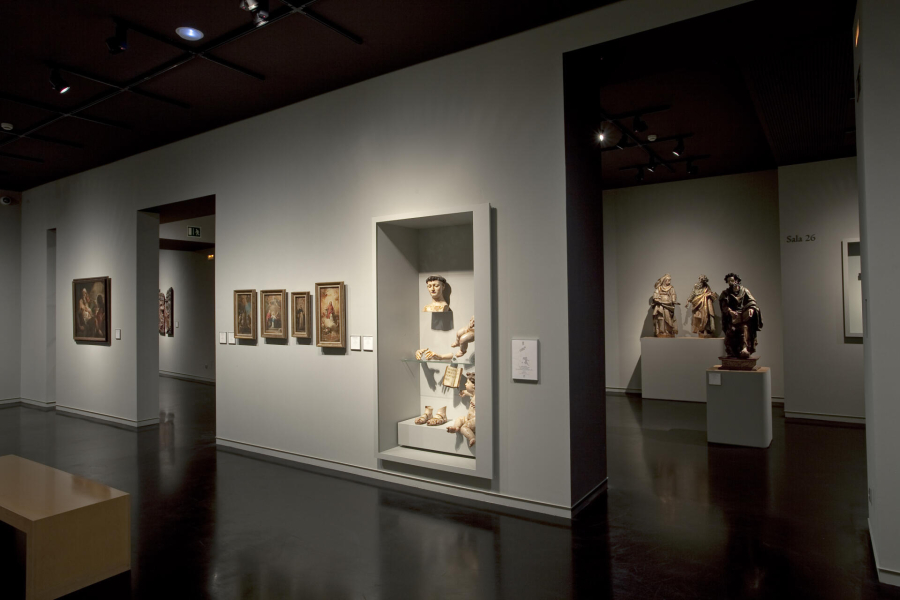
These sculptural fragments can be attributed to this artist and his workshop: the head, hands and feet, two child figures and a book. Thanks to an old photograph, we know that all these fragments belonged to a clothed image of Saint Anthony of Padua. The head is modeled naturalistically, and the features are robust. He looks down to contemplate the Child he was holding in his arms, who corresponds with the figure extending his left arm. The other child was an angel standing at his feet and holding in his left hand the book in which a text from the liturgical service of his festivity is read. All three faces have glass eyes and their hair is treated with deep tufts. Hands and feet completed the main figure. Gregorio Fernández is also the author of another clothed Saint Anthony: the one he made for the church of San Miguel in Valladolid. It differs from ours in that it also has the naked body of the saint sculpted.
Fernández's style stands out for the realism of the figures and the naturalistic modeling of the faces, which make them look like living characters. But what is most remarkable is the spirituality and inner life they convey. The artist created several iconographic types much requested by his clients, as well as monumental processional steps.
This work, the original provenance of which we do not know, was kept in private hands for a long time without losing its devotional function, until it entered the museum.