
Sarcophagus front with biblical scenes
Sarcophagus front with biblical scenes

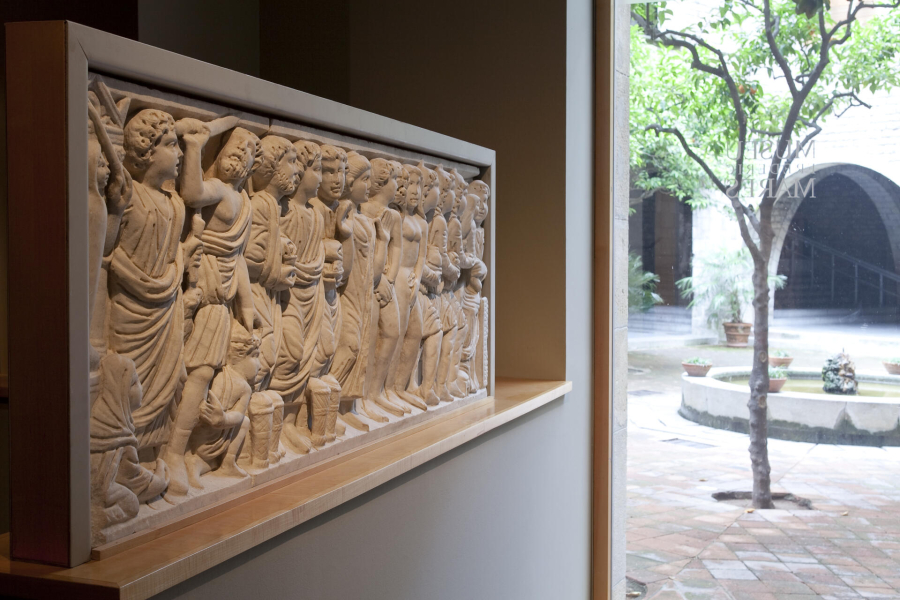
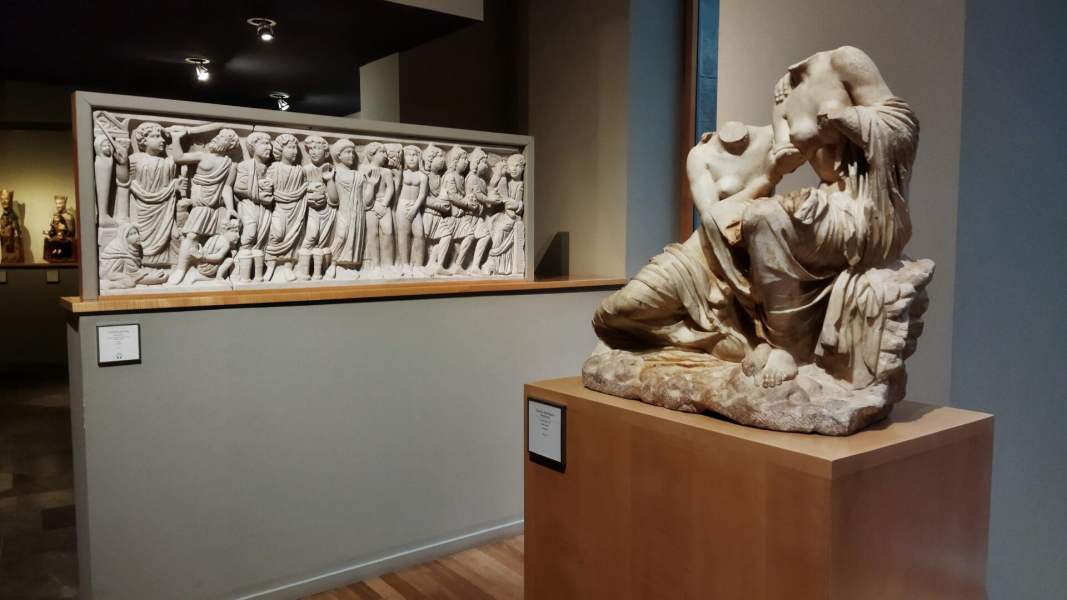
This sarcophagus front was probably made by a Roman workshop during the fourth century of our era, during the mandate of Constantine - the first Christian emperor - and was then exported to Hispania.
In this piece of marble carved in high relief, we see scenes from the Old and New Testament arranged in the form of a running frieze, that is to say, without boundaries separating them.
From left to right: the resurrection of Lazarus , the abraham's sacrifice , the miracle of loaves and fishes , in which Jesus appears between Saint Peter and Saint Andrew, the figure of the person praying or the deceased in the center of the composition, Adam and Eve , and finally the Adoration of the Magi .
These representations are not temporally ordered, but they maintain a parallel between them as they are linked to the divinity of Jesus, the Eucharist and the Redemption. In terms of technique, the use of the drill to highlight details, such as curls of hair, eyes or vegetation, is noteworthy. Other details, on the other hand, such as the hand of God next to Abraham or the figures of the camels in the Epiphany, are worked through a shallower relief that configures a second narrative plan.
The complete sarcophagus was discovered in Layos, province of Toledo, in the 17th century. Later, the front was separated from the sarcophagus to turn it into a sepulcher lauda and the shields of a noble family were sculpted on the back.